Invasive Mechanical Ventilation

Warning

Objectives

To guide the management of patients with respiratory failure requiring invasive mechanical ventilatory support.

Scope

Guidance provided on the initiation of invasive mechanical support, principles of lung protective ventilation, escalating support if deteriorating hypoxaemia and trouble-shooting.

Audience

This guideline is intended for the use of registered healthcare professionals trained in anaesthesia or intensive care medicine fulfilling a role in a critical care setting on deployed operations.

Initial Assessment & Management

Adopt early lung protective ventilation strategy

  • Tidal volume (Tv) 6-8mls/kg predicted body weight (PBW)
  • Plateau Pressure (P plat) <30cmH20

PBW (kg) can be calculated as follows (see also table below):

  • Male: 50 +0.91*(height (cm)- 152.4)
  • Female: 45.5 + 0.91*(height (cm)-152.4)

Allow permissive Hypercapnia

  • Keep pH >7.25 (adjusting RR as required)

Fi02 to target Sp02 > 90% or Pa02 > 8.0kPa

  • Wean Fi02 as soon as able
  • If Fi02 requirements are increasing use optimal PEEP (as per ARDSnet table (see below))

Ensure patient is intravenously fluid replete prior to initiating positive pressure ventilation

Regular recruitment manoeuvres are not routinely recommended.

Advanced Assessment & Management

If Sp02 <90% despite Fi02 > 60% and adequate PEEP

  • Increase sedation and paralyse with NMB (consider NMB infusion).
  • Reduce or reverse I:E ratio
  • Assess cardiac contractility and trend in extravascular lung water.  Use restrictive fluid regieme or consider diuresis.  
  • Consider early proning (see separate checklist)
  • Consider alternative modes of ventilation (eg APRV)
  • Consider if VV-ECMO may be required

Prolonged Casualty Care

Focus on minimising risk factors for Ventilator Associated Pneumonia

  • 30 degree Head Up Tilt
  • Regular subglottic suctioning
  • Continue prophylactic PPI until absorbing feed
  • Oral care (daily toothbrushing, avoid chlorhexidine)
  • Ventilator circuit change only if visibly soiled (or faulty)
  • Daily sedation holds

Weaning from Mechanical Ventilatory Support

Assessing suitability for weaning

  • Ensure optimal analgesia (including regional blocks if post-surgery / trauma) and sedation (RASS -3 to +1)
  • No planned surgery within 6 hours or impending evacuation.
  • Favourable ventilation parameters: Fi02 < 0.6, PEEP <10cmH20, RR < 20/min
  • Minimal vasopressor support (eg < 0.1 mcg/kg/min)
  • Ideally absence of abdominal distension
  • Adequate haemoglobin

Commence weaning of ventilatory support

  • Use CPAP-PSV mode
  • Wean PSV by 2-4cmH20 every 12 hours as directed by ITU physician

Assess daily suitability for Spontaneous Breathing Trial (SBT)

  • Best predictor of a successful SBT is clinical judgement of MDT based on alertness, work of breathing, ability to clear secretions
  • Objective measures such as an RSBI (RR / Tv) < 105 assessed for 1 min can also be taken in to account
  • Use 5 cmH20 CPAP and no PSV via Vela Ventilator or T-tube.  30 minutes is usually sufficient.
  • Terminate SBT if; RR > 35 for >15 mins, Sp02 <90% for > 1 min, CVS instability (worsening tachycardia, hypotension or hypertension)

Extubation

  • Consider 1-2 hour of supported ventilation following SBT to optimise prior to extubation
  • Ensure cuff leak present (with 30cmH20 ventilation)
  • Coordinate with activity on rest of unit (admissions, acuity) and ensure adequate staffing present and aware
  • Consider requirement for extubation onto NIV or HFNO
  • Utilise extubation checklist

Predicted Body Weight with Tidal Volumes

Predicted Body Weight

Height measured toe-toe with a 2m tape

  MALE FEMALE
Height PBW 6ml/kg 8ml/kg PBW 6ml/kg 8ml/kg
5' 0"   /  1.52m 50 300 400 45.5 273 364
5' 2"   /  1.57m 54.6 328 437 50.1 301 401
5' 4"   /  163cm 59.2 355 474 54.7 328 438
5' 6"   /  168cm 63.8 383 510 59.3 356 474
5' 8"   /  173cm 68.4 410 547 63.9 383 511
5' 10" /  178cm 73 438 584 68.5 411 548
6' 0"   /  183cm 77.6 466 621 73.1 439 585
6' 2"   /  188cm 82.2 493 658 77.7 466 622
6' 4"   /  193cm 86.8 521 694 82.3 494 658
6' 6"   /  198cm 91.4 548 731 86.9 521 695
6' 8"   /  203cm 96 576 768 91.5 549 732
6' 10" /  208cm 100.6 604 805 96.1 577 769
7' 0"   /  213cm 105.2 631 842 100.7 604 806


BiLEVEL / DUOPAP

Has the advantage of allowing the patient to take a spontaneous breath at any point during a mandated breath and so improves synchrony and facilitates transitioning to spont breathing.

P low (PEEP).  Start at 5cmH20 unless Fi02 determines higher PEEP required.

P high. Set to achieve Tv of 6-8mls/kg.  Typically 10-15cmH20 higher than P low.

T high and T low.  Initially fix to achieve I:E of 1:2 at rate of 15 /min (14-24/min is the usual range).

PRVC /PC-ACV

A dual mode of ventilation that automatically adjusts the inspiratory pressure to the lowest level required to achieve a pre-determined Tv, and so minimises the risk of barotrauma.

Initial settings

  • Tv 6-8 mls/kg
  • Peak insp pressure 35 cmH20, Plateau pressure < 30cmH20
  • PEEP 5-8 cmH20 (but increased in accordance with Fi02)
  • RR 15/min
  • T insp is normally around 1 sec, to achieve I:E of 1:2

PRVC is not recommended when there is obstructive lung pathology due to fluctuating Tv or if patient ventilatory drive is particularly high.


Optimal PEEP

Fi02 Low PEEP (cmH20) High PEEP (cmH20)
0.3 5 5-14
0.4 5-8 14-16
0.5 8-10 16-20
0.6 10 20
0.7 10-14 20
0.8 14 20-22
0.9 14-18 22
1.0 18-24 22-24

Taken from ARDSnet

High PEEP strategy should be considered in patients with moderate to severe ARDS in whom compliance is evidently improved by the application of PEEP.

PEEP tables provide guidelines only and ventilator settings should be tailored based on an individuals response

Care must be taken to avoid Pplat exceeding 30cmH20, by adjusting Tv targets.


Trouble-shooting

  1. Rapid hypoxaemia
    • Exclude pneumothorax, bronchospasm, pulmonary oedema, PE, endobronchial intubation, mucus plugging
  2. Gradual hypoxaemia
    • Increase Fi02
    • Increase mean airway pressure, by either increasing PEEP or inspiratory time (move to I:E of 1:1 or reversed
  3. Gradual hypercapnia
    • Increase RR
    • Eliminate dead space: Increase inspiratory time, Increase PEEP
    • Check for leaks
    • Assess for dyssynchrony
    • Take care not to increase Tv or P peak or plateau beyond safe levels; it is often preferable to tolerate hypercarbia
  4. Ventilator dyssynchrony
    • Ineffective triggering (commonest): reduce trigger sensitivity
    • Inadequate flow ("fish out of water"): increase flow rate or frequency.  Change from PRVC to BiLEVEL
    • Premature cycling: increase trigger sensitivity
    • Breath-stacking: monitor closely for if obstructive pathology.  Ensure exp flow has ceased prior to next breath.  Reduce T insp to 0.8 sec and increase I:E to 1:4-6.


Prone Positioning

STEP 1- Staff & Equipment

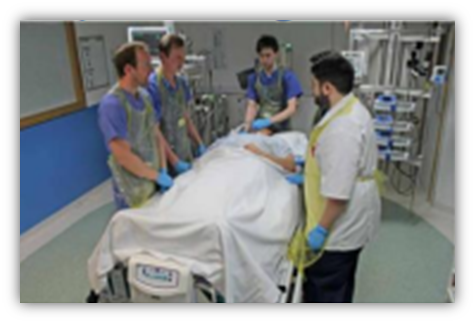
  • Ensure adequate numbers of staff available (5, inc. airway Dr)
    • Introduce themselves and state their role.
    • Airway Doctor positioned at the head end of the patient and is responsible for co-ordinating the procedure. At least two other people either side of the patient, depending on the size of the patient. Additional staff should be allocated to the management of chest drains/ ECMO cannulas if in situ.
  • Consider:
    • Investigations/ procedures/ transfers that may be difficult post proning.
    • Airway trolley checked and available. Note intubation grade and current ETT details.
    • Adequate sedation
    • NBM prior to proning. Document NGT length & skin integrity.
  • Securely tie the ETT, with tapes and pad between ties and skin. Suction oropharynx and airway prior to procedure & ensure closed circuit suctioning is available. If tracheostomy, then change inner tube.
  • Pre-oxygenate with 100% O2.
  • Check ventilator settings- note Vt and pInsp. Perform pre-proning ABG and document results.
  • Ensure all lines/ drains are sutured and secured (above waist to head, below waist to feet).
  • Prepare vasopressor/ inotropes in case of CVS instability & discontinue non-essential infusions and monitoring. ECG electrodes removed.
  • Stop feed and aspirate tube.
  • Clean, lubricate and protect eyes.

STEP 2 - Positioning

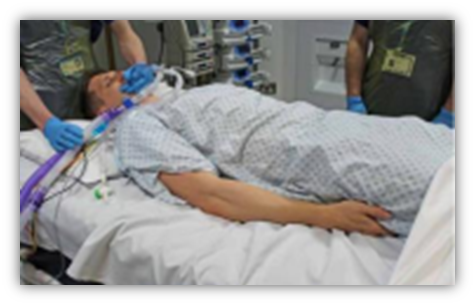
  • Patient should be laid flat with the bed in a neutral position, on a clean sheet with a slide sheet beneath.
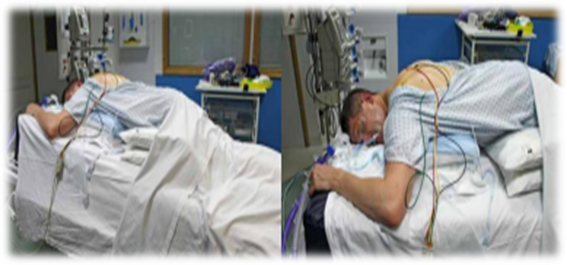
  • The arm closest to the ventilator is tucked underneath the buttock with the palm facing anteriorly (See diagram).

STEP 3 – Wrapping the patient

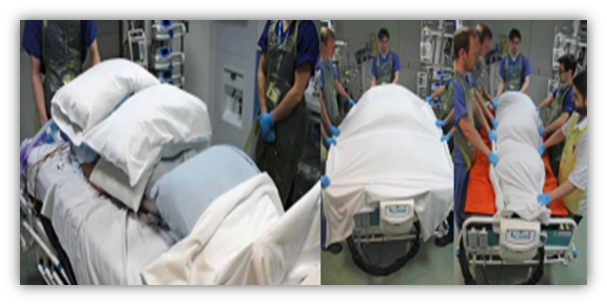
  • Pillows placed over the chest, iliac crest, and knees- strategically, according to the patient’s body habitus to reduce the pressure placed upon the abdomen.
  • A clean bed sheet should be placed on top of the patient leaving only the head and neck exposed The edges from the top and bottom bed sheets are rolled tightly together thereby encasing the patient between the two and keeping the pillows in the correct position on top of the patient.

STEP 4- The ‘Roll’

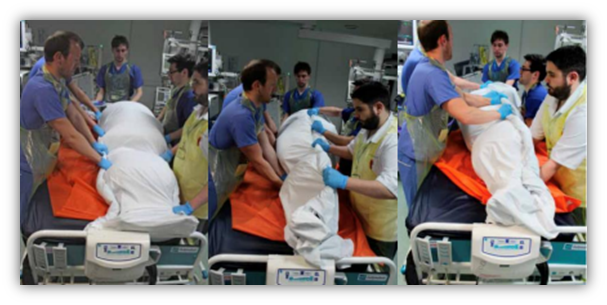
  • Keeping the bed sheets pulled taught and the edges rolled tight, the patient should be moved horizontally to lie on the edge of the bed – the opposite side to the ventilator.
  • On the call of the Airway Doctor, at the head end, whilst maintaining a tight grip on the rolled-up sheets the patient is rotated 90°, to lie on their side (now facing towards the ventilator).
  • Staff on either side should then adjust their hand positions on the rolled-up sheets, so that they now have hold of the opposite edge when compared to the horizontal move.
    • This should be done one hand at a time, led by one person.
  • On the call of the person at the head end, the rolled-up sheet is pulled up from beneath the patient whilst the patient is carefully turned into the prone position. As the patient is moved from lateral to prone, the Airway Doctor is to turn the head to face the ventilator.
    • Ensure the ETT is not kinked and that a CO2 trace is still present on the capnograph. Note the length of the ETT at the lips and review ventilator settings.
    • Reattach the ECG electrodes and ensure all monitoring is re-established.

STEP 5- Repositioning & ‘Swimming’

  • Ensure the patient is in the centre of the bed. Then, remove the slide sheet. An absorbent pad should be placed under the patient’s head for secretions.
  • Position the arms in the ‘swimmers’ position’. Raise one arm on the same side to which the head is facing whilst placing the other arm by the patient’s side.
    • The shoulder should be abducted to 80° and the elbow flexed 90° on the raised arm.
    • The position of both the head and arms should be alternated every two to four hours.
  • The patient should be nursed at 30° in the ‘reverse Trendelenburg’ position.
  • Finishing points:
    • Ensure optimal positioning of pillows tailored to the patient’s body habitus.
    • Pressure areas should be meticulously checked.
      • No direct pressure on the eyes.
      • Ears not bent over.
      • ETT not pressed against the corner of the mouth / lips.
      • Nasogastric tube not pressed against nostril.
      • Penis hanging between the legs with the catheter secured.
      • Lines / tubing not pressed against the skin.

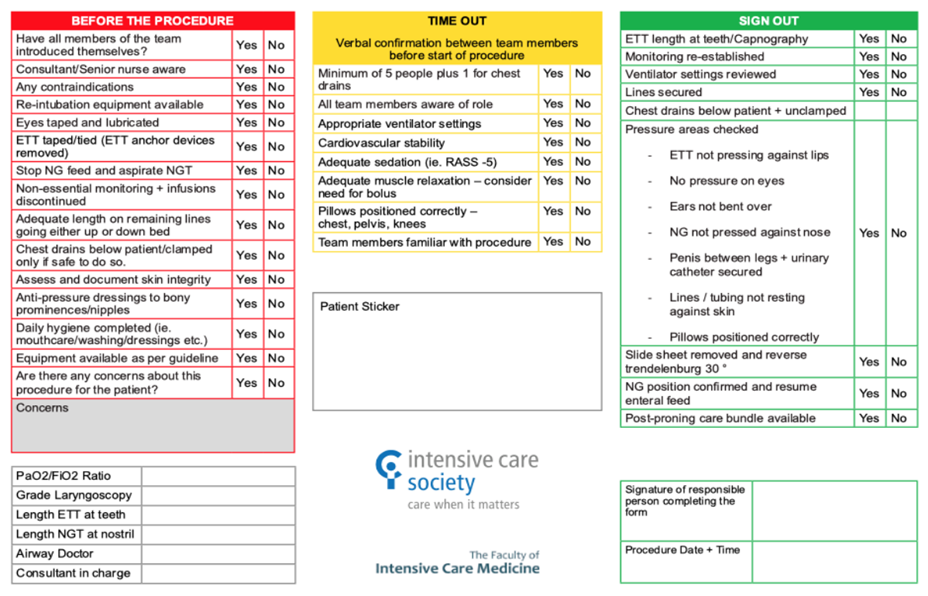
PRONE POSITIONING CHECKLIST

Prone Positioning Checklist

Oxygen Consumption Considerations

In the event of multiple casualties and / or constraints of the austere environment it will be necessary to monitor oxygen supplies

Gas consumption can be estimated from:

(minute ventilation + bias flow) x (Fi02 -0.2/0.8) + cycling requirement)

As a guide for the EVE-TR2 ventilator

- It does not consume oxygen to operate given it has an internal air turbine

- Oxygen flow can be calculated as: 02 Flow (L/min) = (MV + Bias Flow) x (FI02 -21/80)

Bias flow is typically 3L/min

At a minute vol of 8L/min and Fi02 of 60% this equates to 5.4L/min

-  Oxygen flows will be much higher if the ventilator is used for NIV, up to 50 - 60L/min delivering Fi02 100% 


Last reviewed: 28/01/2026

Next review date: 28/01/2027

Related resources