
Sedation, Delirium and Analgesia

Warning

Objectives

Adequate analgesia and sedation is vital to providing effective care to the critically ill patient, seeking to minimise patient discomfort, the physiological and psychological response to stress, allows care to be administered safely whilst avoiding over-sedation and consequent risks of VAP, delays in weaning, ileus, drug toxicity and delirium.

Scope

Guidance is provided on appropriate administration and monitoring of analgesia and sedation.  Also, the routine screening for delirium and measures to minimise the risk and impact.

Audience

Intensive Care Doctors 

Intensive Care Nurses

Deployed Pharmacist

Initial Assessment & Management

Key Principles

  • Control pain first
  • Use the minimum sedation possible
  • Optimise non-drug measures

Key Practices

  • Assess for pain and agitation 4 hourly and delirium 12 hourly
  • Prevent / treat discomfort with attention to positioning, physiotherapy to avoid joint and muscle discomfort
  • Use multi-modal analgesia: non-opioid, opioid, neuromodulators and consider regional anaesthesia wherever possible
  • Use regular analgesia with PRN for breakthrough
  • Daily sedation holds unless contraindicated
  • Aim for light sedation
  • Maintain orientation and reassurance
  • Minimise light, noise & care disturbances

Prolonged Casualty Care

In a resource constrained setting the practice of mixing medications and / or using drop rates may be required.  

The table below presents some accepted combinations, however signs of incompatibility should still be monitored for.  These include change in colour or precipitate leading to cloudiness and phlebitis at the infusion site. All mixtures should be used within 24 hours to minimise risk of microbial contamination.

Drug infusion

Drug dose

Solvent

Total Volume

Final concentration

Recommended dosing

Morphine + Midazolam


30mg Morphine

30mg Midazolam

0.9% saline

30ml

1mg/ml Morphine

1mg/ml Midazolam

0-15ml/hr


Fentanyl + Midazolam

300mcg Fentanyl

30mg Midazolam

0.9% saline

30ml

10mcg/ml Fentanyl

1mg/ml Midazolam

0-15ml/hr


Ketamine + Midazolam


400mg Ketamine

10mg Midazolam

0.9% saline

50ml

8mg/ml Ketamine

200mcg/ml Midazolam

ml/hr= wt (kg) / 4

(anaesthesia dosing*)

Ketamine + Midazolam

800mg Ketamine

20mg Midazolam

0.9% saline

100ml (bag)

8mg/ml Ketamine

200mcg/ml Midazolam

0-25 drops / 3min

(see below)


Ketamine + Fentanyl

400mg Ketamine

500mcg Fentanyl

0.9% saline

50ml

8mg/ml Ketamine

10mcg/ml Fentanyl

0-25ml/hr


* analgesic dosing of ketamine is 0.1-0.3mg/kg, or 1/10th the anaesthetic dose

DROP RATES

Drop dose on giving set is 20 drops/ml (regular giving set).

Infusion rate ml/hr

Drop Rate / 3min

Drop Interval (secs)

20

20

9

25

25

7

Analgesia

Assess pain objectively with the aid of tools such as the Behaviour Pain Score in patients unable to verbalise.

  • This should be performed every 4-8 hours, or shortly after a change in analgesia, with the patient at rest and during noxious stimulus (eg endotracheal suctioning, turning)
  0 1 2
Facial Expression Relaxed, neutral Tense Grimacing
Body movements Absence of movements or normal position Protection Restless / Agitation

Ventilator Compliance

or

Vocalisation


Tolerating ventilator

or

Talking in normal tone or no sound


Coughing but tolerating

or

Sighing, moaning

Fighting ventilator

or

Crying out, sobbing

Muscle Tension

Relaxed Tense, rigid Very tense or rigid
  • Mild pain (0-2):         Review anlagesia and consider adjusting.  Repeat assessment in 4 hours
  • Moderate pain (3-5): Consider bolus analgesia &/or increase background rate.  Consider if regional                                    or neuropathic medications required.  Repeat assessment in 30 minutes.
  • Severe pain (6-8):     Seek medical review, give bolus &/or increase background.

A multi-modal approach to analgesia should be adopted

  1. Non-pharmacological
    • Sleep: Address disruption or deprivation
      • Consider eye mask, ear plugs, environmental noise and light, clustering and timing of interventions, temperature regulation
      • Restoration of sleep-wake cycles by engagement during day light hours
    • Withdrawal syndromes: opioids, benzodiazepines, nicotine, alcohol
    • Anxiety: reassurance, explanation, consider anxiolysis
    • Physical comfort: attend to positioning, physiotherapy to reduce joint pain and muscular stiffness, support of fractures
    • Relief of urinary retention or gastric distension
  2. Pharmacological
    • Non-opioid
      • Paracetamol is established as an opioid-sparer and also has potent anti-pyretic effect.
      • NSAIDs are useful adjuncts, but care is advised in AKI and erosive gastritis.
    • Pregabalin and amitriptyline should be used first line for neuropathic pain.
      • Pregablin start at 75mg BD, increase to 300mg BD
      • Amitriptyline start at 10mg ON, increase to 75mg ON
    • Opioids
      • Are the mainstay of pharmacological management of pain in the ICU
      • Fentanyl has the major advantage over morphine of less accumulation with prolonged use, particularly with renal impairment.
    • Ketamine
      • Induces a dissociative anaesthesia, with sedative & analgesic properties, is cardio-stable and preserves airway tone and reflexes.  However, re-ermergence phenomena with hallucinations limits use, this can be attenuated with co-administration of midazolam.
      • 0.1-0.2mg/kg bolus or 0.1mg/kg/hr infusion (note this is 5-10% the anaesthetic dose)
    • Clonidine
      • Main use is as a second-line sedative, particularly if control of hypertension and tachycardia is desirable, or to help manage withdrawal from benzodiazepines or opiates.  At higher doses also has analgesic effect that can spare opioids.
        • Usual dose is 0.5-2.0mcg/kg/hr (up to 4.0mcg/kg/hr)
        • Caution in patients with impaired cardiac output and renal dysfunction.
        • Weaning should occur gradually (eg over 6-8 hours).
    • Note propofol has no analagesic properties
  3. Regional Analgesia
    • Has been shown to be superior to opiate infusions or PCAs and should be considered whenever possible.
    • Contra-indications include spinal injuries, acute neurological injury and coagulopathy
    • Erector spinae plane (ESP) block and Serratus Anterior Plane blocks should be considered for rib fractures where the patient is unable to deep breath or there is moderate to severe pain on coughing.
      • Serratus Anterior plane block anterior or lateral fractures (particularly 3-9), morbid obesity, unable to sit or roll
      • ESP in posterior fractures
      • Femoral nerve and brachial nerve blocks are useful for lower and upper limb injuries.
Sedation

Initial sedation is normally with

  • Propofol (1%) 5-20mls/hr or 0.3-4.0mg/kg/hr.
  • Fentanyl (50mcg/ml) usual range 0.5-3.0 mls/hr (0.75-2mcg/kg/hr).

Adequacy of sedation is assessed via the Richmond Agitation and Sedation Scale (RASS) 4 hourly

Score Term Description   Suggested Adjustment of sedation
+4 Combative Overtly combative, violent, immediate danger to self or staff   Bolus and increase infusion by 30%
+3 Very agitated Pulls or removes tube(s) or catheter(s); aggressive   Bolus and increase infusion by 30%
+2 Agitated Frequent non-purposeful movement; fights ventilator   Bolus and increase infusion by 20%
+1 Restless Anxious but movements not aggressive or vigorous   Bolus and increase infusion by 10%
0 Alert & Calm     No change
-1 Drowsy Not fully alert, but sustained awakening (eye opening / eye contact to voice > 10 sec)   No change
-2 Light sedation Briefly awakens with eye contact to voice < 10 sec   Reduce infusion by 20%
-3 Moderate sedation Movement or eye opening to voice (but no eye contact)   Reduce infusion by 30%
-4 Deep sedation No response to voice, but movement or eye opening to physical stimulation   Reduce infusion by 75%
-5 Unrousable No response to voice or physical stimulation   Hold infusion


The target RASS score should be clarified with the intensive care physician, but would normally be -2 to +1 and should be assessed two hourly.

The rare instances where deep sedation would routinely be indicated include;

  • Severe ARDS, Status Epilepticus, Intracranial Hypertension, Patients who require on-going paralysis or in whom movement needs to be minimised (vulnerable injuries or grafts)

If RASS score remains high

  1. Consider cause
    • Inadequate analgesia (Seek to address this first).
    • Pain which is difficult to control in the military trauma or burns patient (or more rarely in those with cellulitis) should prompt consideration of compartment syndrome
    • Delirium (see separate section) & anxiety
    • Withdrawal syndromes (alcohol, nicotine, opiods, psychoactive medications)
    • Underlying illness; marked SIRS, brain injury leading to paroxysmal sympathetic hyperactivity.
    • Ventilator dysynchrony (see Invasive Mechanical Ventilation)
  2. Up-titrate Propofol and Fentanyl rates first
    • Care must be taken to avoid exceeding maximum dose of Propofol, particularly in younger patients given the risk of Propofol Infusion Syndrome (see separate section)
  3. Additional medications if required include
    • Clonidine 2mcg/kg/hr (1500mcg in 50ml N Saline)
    • Midazolam 2-5mg/hr (60mg in 60ml N Saline)

In selecting sedative agent consider

  • likely duration of sedation required, renal or liver impairment, medication availability
    • A combination of pre-mixed morphine and midazolam may be considered if deep and prolonged sedation is likely to be needed in a number of patients in a resource limited setting (to preserve shorter acting agents and infusion pumps)

Adopt early sedation holds

  • twice daily unless contraindicated
    • Traumatic brain injury with suspected raised ICP
    • Difficult ventilation with poor gas exchange
    • Paralysed with neuro muscular blockers
  • avoiding the complications of sedation is as important as pharmacological sedation

If RASS remains suppressed despite sedation hold

  • consider new or progression of an intracerebral lesion (including infection) and non-convulsive status epilepticus

Delirium

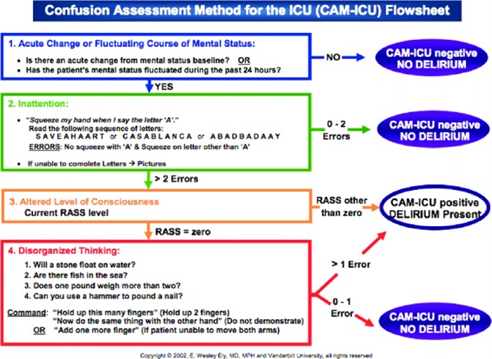
Delirium in ICU Good sedation practices should be complemented by non-pharmacological approaches such as improvements in ICU sound, light control, floor planning, room arrangement and night and day cycles. In a deployable role this is more difficult but creating an environment that is as normal as possible is paramount.

Assess using CAM-ICU

If delirium evident

1. Identify and treat cause

  • Pain, anxiety, hypoxia, hypercapnia, hypoglycaemia, infection, dehydration, drug withdrawal, drug side effects, bowel and bladder management

2. Optimise non-pharmacological measures

  • Reassure and re-orientate
  • Use familiar objects, voices
  • Use communication aids
  • Address sleep disturbance (see under sedation)
  • Early mobilisation
  • Minimise lines, catheters, alarms

3. If patient or staff safety is compromised utilise medications

  • Haloperidol 2-5mg/ml injection, every 20-30 minutes
    • caution if multiple (2) other QT prolonging drugs are in use &/or QTc > 450msec.
    • Side effects include extrapyramidal effects and neuroleptic malignant syndrome
  • Olanzapine 5-10mg OD orodispersible tablet
  • Medications are not recommended for hypoactive delirium

Propofol Infusion Syndrome (PRIS)

This is a rare but potentially fatal syndrome associated with high dose (>4mg/kg/hr) and duration (>48hrs) of infused propofol.

Features include

Progressive cardiac dysfunction (bradyarrythmias, marked ECG changes (mimicking Brugada syndrome (ST Elevation V1-3, RBBB, ventricular tachycardia, broadening of QRS), cardiac failure)

Severe metabolic acidosis

Hyperkalaemia

Acute renal failure

Rhabdomyolysis

Supportive management is mainstay of treatment, but the prompt recognition, cessation of Propofol and removal of propofol and its metabolites via RRT is essential

Bradycardia may be resistant to catecholamines and requires external pacing. 

Last reviewed: 24/01/2026

Next review date: 24/01/2027