
Transfusion Reactions

Warning

Objectives

Improve understanding and management of acute transfusion reactions (ATRs) and improve safety of blood transfusion

Scope

Definition of transfusion reactions 

Types of transfusion reactions

Identification and Management approach to transfusion reactions, link to anaphylaxis CGO

Audience

This guideline is intended for use by registered healthcare professionals fulfilling a general role in forward medical locations or in an emergency department in a deployed hospital setting.

Definitions and Principles

Acute transfusion reactions

Acute transfusion reactions (ATRs) are defined as those occurring within 24 hours of the administration of blood or blood components.  They include more common (and likely underreported) mild/moderate reactions, and severe reactions which are rarer. Examples of ATRs include:

Moderate / Severe

  • Severe allergic
  • Haemolytic transfusion reactions (HTR)
  • Transfusion related acute lung injury (TRALI)
  • Transfusion associated circulatory overload (TACO)

Minor

  • Febrile non-haemolytic transfusion reactions (FNHTR)
  • Mild allergic reactions

Delayed haemolytic reactions can present after days to weeks. Therefore, observation and monitoring are required throughout the transfusion episode and patients should be asked to report symptoms which develop after transfusion, particularly fever, dark urine, jaundice or symptoms suggestive of anaemia.

Underlying principles

Although it is useful to categorise ATR for reporting and research purposes, patients with severe ATR often present with an overlapping complex of symptoms and signs.

The initial clinical picture is also often obscured by factors related to the patient's underlying medical conditions, such as febrile septic episodes in patients who also happen to be receiving a blood component transfusion.

For this reason, this guideline will consider all causes of a possible reaction during blood transfusion and focus on initial recognition and general management of the clinical problem, guided in the main by symptoms and clinical signs and assessment of the severity of the problem.

Clinical setting

Where feasible, patients should be transfused in clinical areas where they can be directly observed by staff trained in the administration of blood components. including treatment of anaphylaxis.
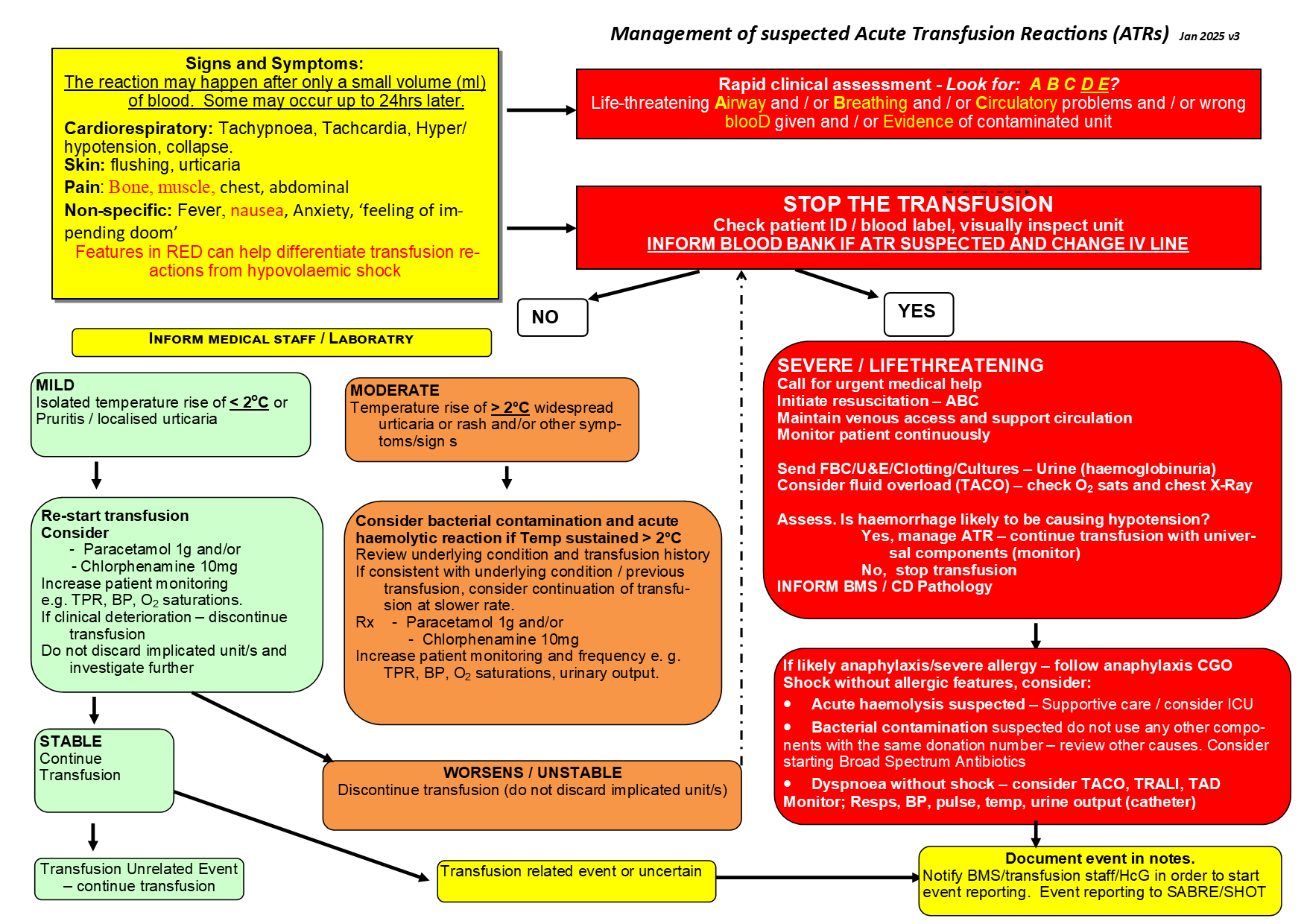
Initial Clinical assessment

Initial Clinical Assessment

Initial assessment aims to rapidly identify patients with serious or life-threatening reactions so that treatment can be immediately initiated. 

Reactions may happen after only a small volume of blood and can be delayed (> 24hrs).

Signs and symptoms

  • Cardiorespiratory: Tachypnoea, Tachycardia, Hyper/hypotension, collapse.
  • Skin: flushing, urticaria
  • Pain: Bone, muscle, chest, abdominal
  • Non-specific: Fever, chills, nausea, generally unwell, anxiety, ‘feeling of impending doom’

Immediate actions:

STOP TRANSFUSION (unless haemorrhage) and venous access should be maintained with physiological saline. The patient's airway, breathing and circulation (‘ABC’) must be assessed.

Check patient identification details to ensure that they correspond with those on the blood component compatibility label. Is the reaction due to transfusion of a component intended for another patient? Are the ABO blood groups compatible?

Examine component for unusual clumps or particulate matter, or discolouration suggestive of bacterial contamination.

Provided that the reaction is not severe or life-threatening, standard observations on the patient are then performed

Hypotension: If a patient being transfused for haemorrhage develops hypotension, careful clinical risk assessment is required. If the hypotension is caused by haemorrhage, continuation of the transfusion may be life-saving. In contrast, if the blood component is considered the most likely cause of hypotension, the transfusion must be stopped or switched to an alternative component and appropriate management and investigation should be commenced.

Acute Transfusion reaction Flowchart

ATR Flowchart


Severe / Life Threatening reactions

  • STOP TRANSFUSION 
  • Call for help
  • Initiate resuscitation Airway, Breathing, Circulation
  • Monitor vital signs

Specific scenarios: 

Anaphylactic / severe allergy

Features: Shock and hypotension associated with stridor / wheeze, angioedema and/or urticaria.

Requires immediate intervention with IM adrenaline as anaphylaxis CGO. Adult > 12 years 0.5mL of 1:1000 adrenaline, repeated at 5 min intervals according to response. 

Supportive measures:

Rapid fluid challenge - 500 - 1000mL crystalloid

10mg Chlorphenamine IM or slow IV 

Inhaled B2 agonists

Shock / severe hypotension without clinical signs of anaphylaxis or fluid overload

Consider ABO blood group incompatibility or bacterial contamination. Initiate supportive care with fluid resuscitation, expert evaluation for inotropic, renal and/or respiratory support and blood component therapy for disseminated intravascular coagulation with bleeding. 

  • Suspected bacterial contamination - Blood cultures from a peripheral vein and any central lines should be performed. The component should be sealed and transported to the transfusion laboratory as soon as possible. Commence broad spectrum antibiotics as per local policy. 
  • Acute haemolytic transfusion reaction - Consider if moderate or severe febrile symptoms, hypotension or back/loin pain, compatibility testing should be performed. Testing should include repeat ABO/D grouping of the patient, crossmatch and a direct antiglobulin test.

Immediately notify CD Pathology. 

Severe Dyspnoea without shock

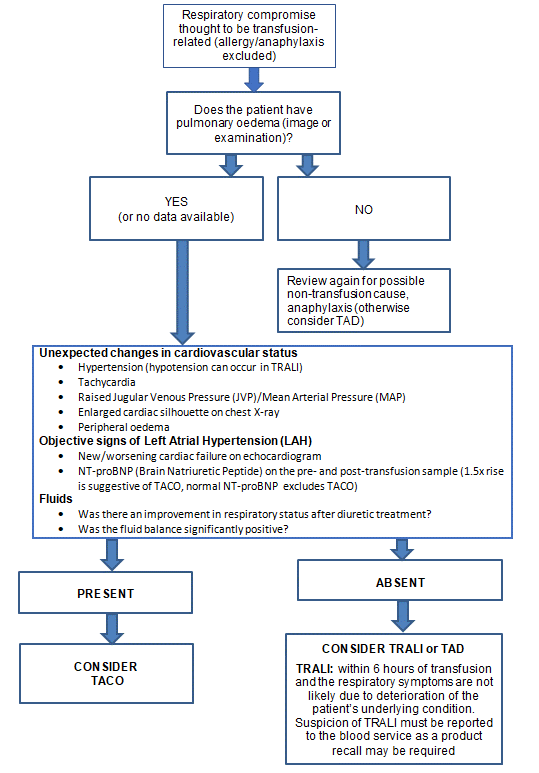
Potential causes of dyspnea without shock include: Transfusion associated circulatory overload (TACO), Transfusion associated acute lung injury (TRALI) and Transfusion associated dyspnoea (TAD). Diagnosis is usually made clinically. See flowchart from BSH ATR guideline.

Laboratory testing

In the deployed setting, specialised testing may not be feasible (e.g. Anti-body screening, mast cell tryptase). Initial testing should be considered (in line with MFT capability). 

suggested baseline investigations:

  • Full Blood Count
  • Urea and Electrolytes
  • Clotting screen (inc. fibrinogen)
  • Blood cultures
  • Assess fluid overload - consider chest x-ray, blood gas analysis. 
  • Urinalysis - haemoglobinurea

Mild / Moderate reactions

Moderate reactions: Differential as per severe reactions

Moderate Febrile reactions

Temperature ≥39°C or a rise of ≥2°C from baseline and/or systemic symptoms such as chills, rigors, myalgia, nausea or vomiting. 

If the reaction is sustained, bacterial contamination or a haemolytic reaction should be considered.

If the reaction is transient and the patient recovers with only symptomatic intervention bacterial contamination or a haemolytic reaction is unlikely. 

Moderate allergic symptoms

Signs and symptoms may include angioedema and dyspnoea, but not sufficiently severe to be life-threatening. Antihistamines such as chlorphenamine orally or IV may be effective and in addition oxygen therapy and a short-acting inhaled beta-2 agonists such as salbutamol may be useful for respiratory symptoms.  Corticosteroids act only to downregulate the late-phase inflammatory response and have no role in managing acute symptoms.

Moderate respiratory

The decision to continue transfusion will depend on the clinical assessment of the probable cause of the symptoms, response to initial therapy and the urgency of transfusion.

Mild reactions 

Patients with mild isolated febrile reactions may be treated with oral paracetamol (500–1000 mg in adults). Patients with mild allergic reactions may be managed by slowing the transfusion and treatment with an antihistamine. Corticosteroids should not be used routinely.

Follow-up

Blood components and empty bags / giving sets should be retained and returned to laboratory for investigation, as directed by BMS

When no BMS present, liaise with CD Pathology at earliest opportunity for direction.

All transfusion reactions must be reported to the BMS and/or clinician responsible for transfusion. reporting of moderate / severe reactions to MHRA via SABRE /SHOT is a legal requirement (via BMS and CD Pathology). Transfusion related incidents should concurrently be reported though MTF clinical governance processes.

In cases of moderate or severe allergic reactions - Onward referral to an immunologist should be considered. 

Last reviewed: 03/11/2026

Next review date: 03/11/2027

Evidence method

Reviewed out of committee with DMSTC Chair and RP Blood Jan 25

based on previous ATR CGO - Approved DMSTC 2013

Updated in line with BSH ATR Guidance 2023