Biodefence
Warning
Objectives
- Provide a structured, operationally relevant approach to the assessment and management of febrile or undifferentiated illness in environments where biological warfare (BW), high consequence infectious diseases (HCID), or tropical infections are possible.
- Support early recognition of biological threats, safe clinical practice, and timely escalation to specialist infection and public health teams.
- Promote consistent PPE discipline, isolation practice, and force health protection (FHP) measures across deployed settings.
- Ensure rapid, accurate communication with reach back infectious disease, pathology, and public health assets.
Introduction
Operational environments may expose personnel to a wide range of infectious hazards, including endemic tropical diseases, zoonoses, and potential BW agents. Early symptoms are often nonspecific, and common infections remain the most likely cause of illness. However, certain presentations—haemorrhage, severe respiratory compromise, CNS involvement, eschars, or rapidly progressive systemic illness—should prompt consideration of high risk pathogens.
This guideline provides a structured approach to recognising, investigating, and managing such cases while maintaining safety, operational capability, and compliance with HCID and FHP principles.
Scope
- Applies to deployed medical personnel managing undifferentiated fever, rash, haemorrhage, respiratory illness, CNS symptoms, or GI syndromes in operational theatres.
- Covers naturally occurring tropical diseases, BW relevant pathogens, and HCID level threats.
- Integrates clinical, operational, and public health considerations without providing prescriptive treatment regimens.
- Complements, but does not replace, specialist infection advice, Defence Public Health guidance, or national HCID frameworks.
Audience
- Deployed clinicians at Role 1–3.
- CBRN medical advisors and operational planners.
- Preventive medicine, public health, and bio-surveillance teams.
- Laboratory liaison officers and Defence Pathology personnel.
- Commanders requiring medical input for operational decision making
Initial Assessment & Management
Presentation
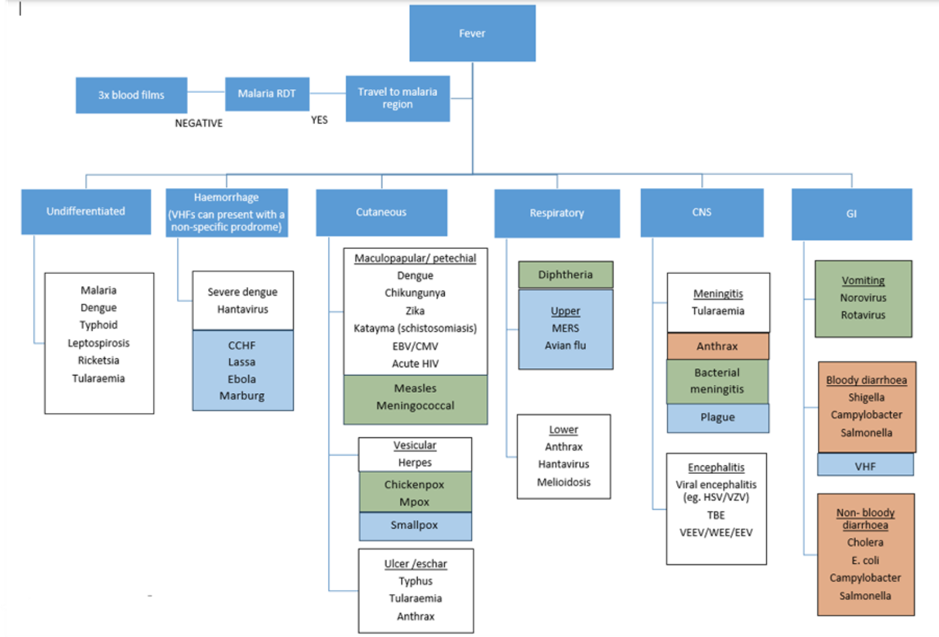
Management of infection patients prior to a definitive diagnosis will be on a syndromic basis. The following syndromic categories will support rapid operational triage and initial investigation and management:
Undifferentiated Fever
Malaria, dengue, typhoid, leptospirosis, rickettsial disease, Q fever, chikungunya, Zika, Katayama fever.
BW relevant: tularaemia, anthrax (systemic), plague (septicaemic).
Haemorrhagic Syndromes
Viral haemorrhagic fevers (Lassa, CCHF, Ebola, Marburg).
Severe dengue, hantavirus, leptospirosis.
High suspicion triggers HCID precautions.
Cutaneous Lesions
Eschars: anthrax, rickettsia, tularaemia.
Vesicular/pustular rash: smallpox, mpox, VZV/HSV.
Maculopapular rash: dengue, chikungunya, Zika, measles.
Respiratory Syndromes
Hantavirus, Q fever, melioidosis, diphtheria.
BW relevant: pneumonic plague, inhalational anthrax.
CNS Syndromes
Viral encephalitis (HSV/VZV, arboviruses), TBE, meningococcal disease.
BW relevant: anthrax meningitis, plague meningitis, equine viruses
Gastrointestinal Syndromes
Cholera, norovirus, rotavirus, Shigella, Salmonella, Campylobacter.
Consider typhoid, Katayama fever, and VHF with GI dominant prodrome.
Investigation
Investigations must be guided by safety, operational feasibility, and specialist advice.
Immediate Priorities
Apply appropriate PPE based on presenting syndrome and risk category.
Isolate the patient according to HCID, droplet, contact, or standard precautions.
Notify infection and public health reachback teams early.
Exposure and Risk Assessment
Consider the following factors when reviewing exposure risk;
- Travel history (region, rural/urban, malaria risk in last 3 years).
- Water/food exposures.
- Accommodation type and vector exposure.
- Freshwater or seawater contact.
- Animal, rodent, or insect exposure.
- Sexual exposures.
- Vaccination history and malaria prophylaxis adherence
- Unwell contacts or cluster patterns.
- Potential deliberate release indicators.
Laboratory and Diagnostic Considerations
Follow Defence Pathology capability guidance
Alert laboratories before sending specimens for suspected HCID or BW agents.
Maintain chain of custody if deliberate release is suspected.
Use rapid tests (e.g., malaria RDT) where available and safe.
Management
This guideline provides principles, not drug regimens.
General Principles
Prioritise supportive care: fluids, oxygen, monitoring, symptom control.
Escalate early to specialist infection advice.
Avoid aerosol generating procedures unless essential and PPE is appropriate.
Maintain strict PPE discipline and minimise staff exposure.
Consider evacuation to higher level of care if clinically or operationally required.
Syndromic Management Priorities
Haemorrhagic illness: treat as HCID until proven otherwise.
Severe respiratory illness: consider plague, anthrax, Q fever, melioidosis, diphtheria.
Eschars: consider anthrax, rickettsia, tularaemia.
Vesicular/pustular rash: differentiate smallpox/mpox from VZV.
Undifferentiated fever: consider malaria first, then regionspecific threats.
Advanced Assessment & Management
Operational Coordination
Inform command of potential impact on force health and mission capability.
Activate FHP measures (vector control, hygiene reinforcement, exposure logs).
Coordinate with CBRN advisors if deliberate release is suspected.
Follow Up
Maintain daily clinical review and exposure monitoring.
Track symptom progression, recovery, and any secondary cases.
Liaise with the Military Public Health teams to ensure contact tracing is performed and appropriate infection prevention control measures undertaken.
Support reintegration of recovered personnel in line with FHP policy.
Conduct after action reviews for suspected BW or HCID events.
Public Health and Infection Control Considerations
PPE and Isolation
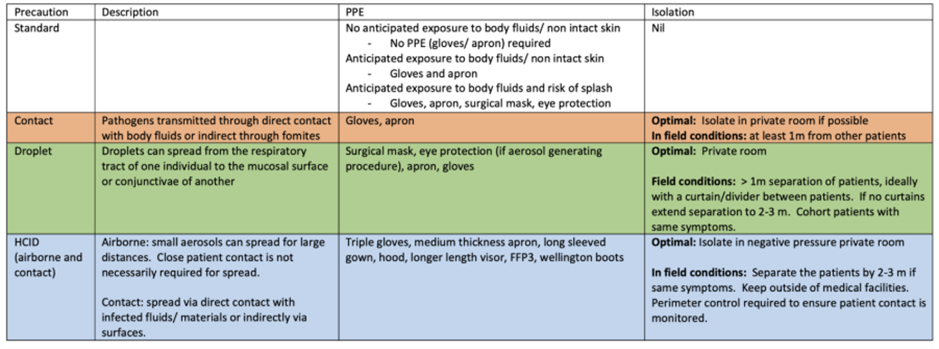
PPE can be considered in four subcategories;
Standard precautions
Contact precautions
Droplet precautions
HCID (airborne + contact) precautions
Apply the highest category compatible with the suspected syndrome.
Review the NHSE PPE guidance for HCID for further detail.
Infection Control
Ensure appropriate patient separation (1–3 m depending on category).
Maintain strict environmental cleaning and waste management.
Use perimeter control for HCID level threats.
Cohort patients only when safe and appropriate.
Public Health Coordination
Notify Defence Public Health immediately for suspected HCID, clusters, or BW relevant presentations.
Provide full exposure and travel history.
Support epidemiological investigation and contact tracing.
Implement FHP measures: vector control, water/food hygiene, vaccination review.
Paediatric Considerations
Principles as per adult and drug dosing iaw age per page