
Cyanide or Hydrogen Sulphide Exposure
Warning
Objectives
To guide the management of patients presenting to medical services with suspected cyanide poisoning or poisoning with hydrogen sulphide.
Scope
This guidance describes the acute diagnosis and treatment of cyanide poisoning.
Audience
This guideline is intended for the use of registered healthcare professionals fulfilling a general role in a forward medical location or in an emergency department on deployed operations.
Initial Assessment & Management
Recognition and diagnosis
Hydrogen cyanide gas has a smell of bitter almonds. However, 20% to 40% of people are genetically unable to smell it.
It is less dense than air and therefore tends to disperse rapidly.
Hydrogen sulphide exposure can present in a similar manner (it is another chemical asphyxiant). This has a smell of bad eggs. However, at higher concentrations or on chronic exposure people may lose the ability to smell it.
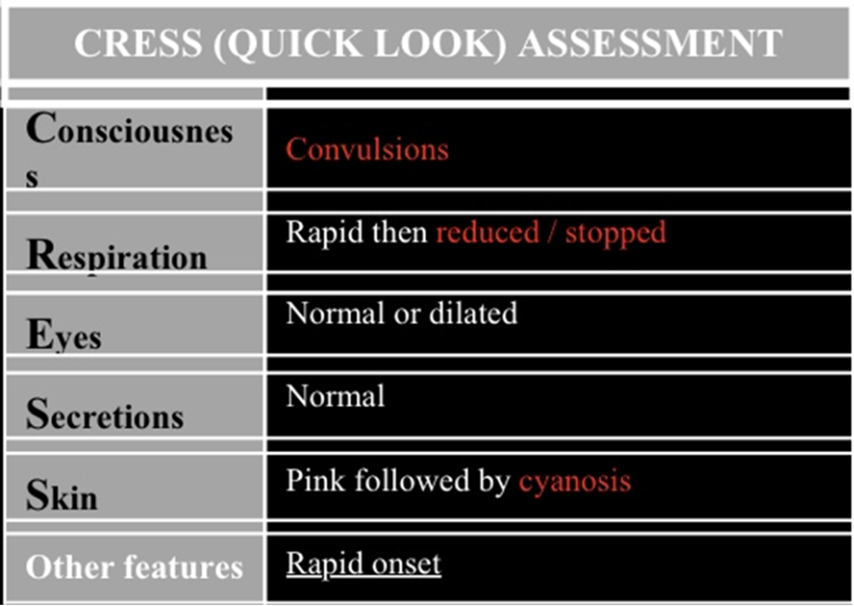
Signs, symptoms and initial results suggesting cyanide exposure include:
- Flushing, initially “cherry red” skin.
- Headache
- Nausea
- Dizziness
- Confusion
- Elevation of respiratory rate with erratic respiration subsequently.
- Loss of consciousness.
- Seizures/rigidity.
- Respiratory arrest
- Raised lactate. Mild poisoning tends to be associated with a lactate of 2mmol/l to 8mmol/l. Moderate poisoning 8mmol/l to 11mmol/l. Severe poisoning >11mmol/l.
Initial management
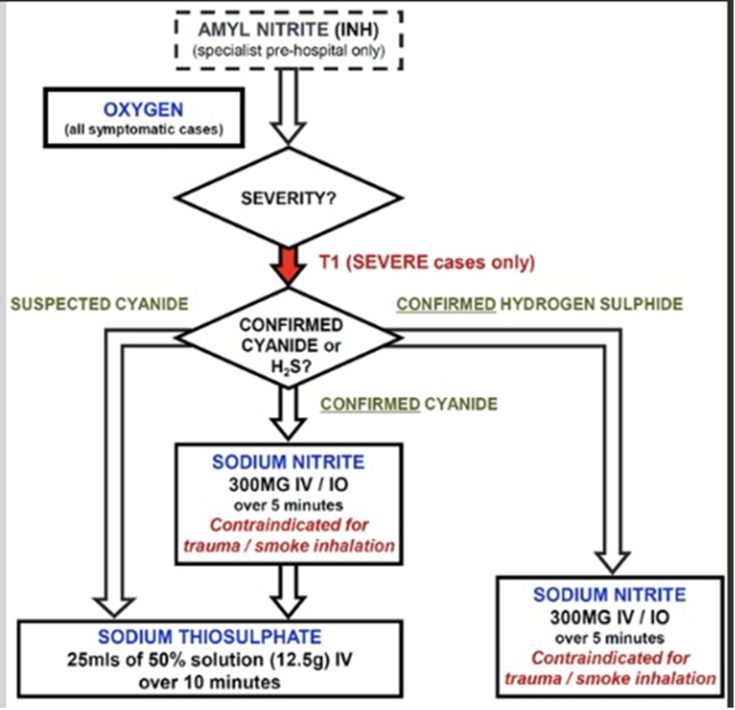
Amyl Nitrite (inhalation, if GSR is worn) can be administered - follow the drill in JSP 926.
Oxygen (not with Amyl Nitrite, if GSR not worn).
Advanced Assessment & Management
Sodium Nitrite 300mg IV/IO, for confirmed cyanide poisoning. Avoid if trauma or carbon monoxide poisoning. When possible, Methaemoglobin levels should be checked when used.
Sodium thiosulphate 12.5g IV, 25mls of 50% solution over 10 mins
Partner Nations or civilian healthcare organisations may use Hydroxocobalamin 5g IV
When possible both arterial and venous blood gases should be taken. In the presence of significant cyanide toxicity, it is expected that the lactate is likely to be elevated. A greater than expected oxygen concentration in the venous blood sample is suggestive of cyanide toxicity.
Methaemoglobin levels should be checked. Hydrogen sulphide toxicity may be associated with methaemoglobinaemia. Also, the Amyl Nitrite and Sodium Nitrite exert their beneficial effects by leading to Methaemoglobinaemia. The effect should be checked to ensure that the methaemoglobin levels do not reach harmful levels (see accordion content).
Check full blood count, U and E, LFTs, CK when able.
Monitor routine observations.
Seizures may require treatment with Benzodiazepines.
Critical Care support may be required in significant exposures.
Prolonged Casualty Care
Supportive management including airway management, correction of hypoxia and fluid management.
If metabolic acidosis persists then consider correction with intravenous Sodium Bicarbonate.
As above, repeated arterial and or venous blood gas measurements will be helpful. Particularly for monitoring pH, lactate and methaemoglobin levels (when able).
Paediatric Considerations
Principles as per adult and drug dosing iaw page per age
Cyanide has a high affinity for ferric ions in mitochondrial cytochrome oxidase. This combination inhibits the enzymatic function in the electron transport chain and the production of ATP through aerobic respiration. This also leads to reduced cellular oxygen utilisation (hence the raised oxygen concentration in a venous blood gas) and an accumulation of lactic acid produced through anaerobic respiration.
The cytochrome oxidase-cyanide complex is dissociated through an enzymatic reaction catalysed by rhodanese. This transfers sulphur from thiosulphate to bind with cyanide to form thiocyanate. This is excreted via the kidneys.
Cyanide can also bind to the ferric iron in methaemoglobin to form cyanomethaemoglobin.
Hydrogen sulphide is thought to disrupt the electron transport chain through effects on cellular enzymes such as cytochrome oxidase. This leads to an inhibition of aerobic respiration leading to decreased ATP production and generation of lactic acid.
Sodium nitrite and amyl nitrite
These change ferrous iron to ferric iron in haemoglobin. This creates methaemoglobin. This binds cyanide to form cyanomethaemoglobin. This prevents the cyanide binding to the cytochrome oxidase where it exerts it’s major toxic effects.
If methaemoglobin levels are excessive then they can lead to toxicity. This can present as cyanosis (low oxygen saturations) unresponsive to supplemental oxygen. The methaemoglobin level can be monitored on an arterial or venous blood gas. Levels up to 30% are generally tolerated well.
They are contraindicated in patients who may have had smoke inhalation/carbon monoxide exposure or trauma. Such patients may be at risk from significant methaemoglobin production. Recreational drugs (“Poppers”) or therapeutic agents may lead to raised methaemoglobin levels.
Other side effects of nitrites include vasodilation and hypotension.
Notably hydrogen sulphide toxicity may lead to methaemoglobinaemia. Therefore, methaemoglobin levels should be checked as soon as possible in patients exposed to hydrogen sulphide or treated with nitrites.
Sodium thiosulphate
This acts as a source of sulphane sulphur for the reaction catalysed by rhodanese. This leads to the enhanced detoxification of cyanide by combining it to a sulphur to form thiocyanate which can be renally excreted.
Hydroxocobalamin
This binds one to one with cyanide to detoxify it.
The most significant risk from the use of the antidotes is the potential for excessive production of methaemoglobin with amyl nitrite and sodium nitrite. Methaemoglobinaemia can also arise through hydrogen sulphide poisoning. To mitigate against these risks, when possible, methaemoglobin levels should be checked on an arterial or venous blood gas sample.
If patients develop toxicity from methaemoglobinaemia then methylthioninium chloride can be used to treat this. Methaemoglobin levels below 30% are generally well tolerated.