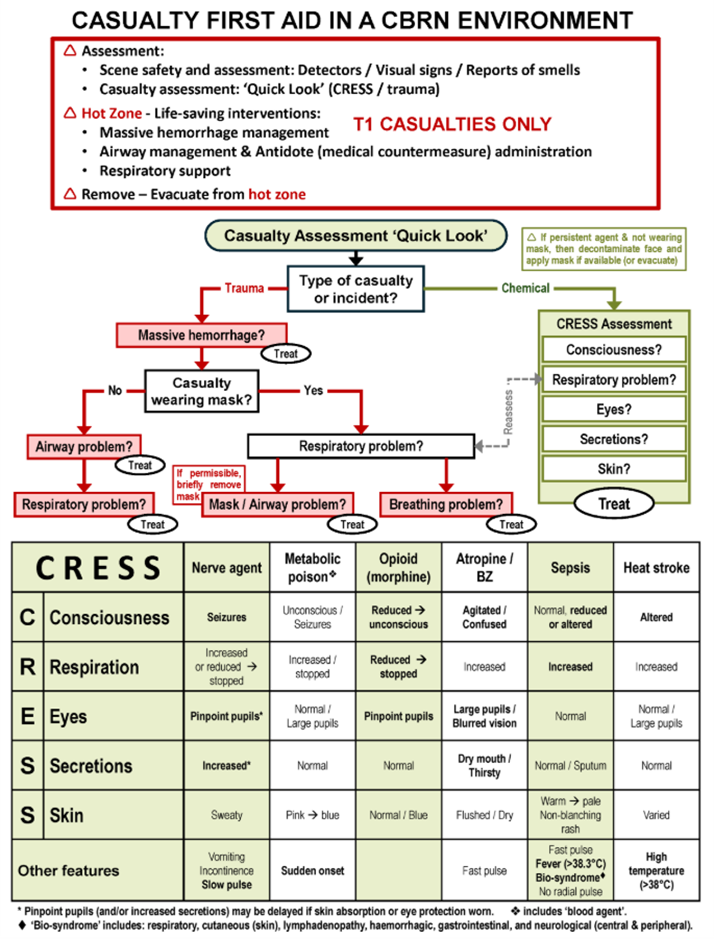
| Consciousness | Unconscious or fitting |
| Respirations | Respiratory distress, high or low RR, apnoea possible |
| Eyes | Pinpoint pupils (miosis) may be present if no mask worn |
| Skin | Sweaty, fasciculation may be seen if liquid contact with skin |
| Secretions | Excessive respiratory secretions especially if vapour inhaled |
| Additional | Vomiting, urination, defecation, bradycardia, (sometimes paradoxical tachycardia and hypertension can occur) |
Nerve Agents
Warning
Objectives
To guide the management of patients presenting to medical treatment facilities with suspected chemical warfare Nerve Agent poisoning in the deployed environment.
Note that chemical warfare (CW) agents may be utilised alongside conventional munitions resulting in combined ballistic injury and CW intoxication
Scope
To provide treating clinicians at Role 1-3 MTF with initial management guidance on casualties diagnosed with suspected nerve agent poisoning.
Further detailed advice is available in AMedP 7.1 or via Reachback to DCA CBRN
Audience
This guideline is intended for the use of registered healthcare professionals fulfilling a general role in forward medical locations or in an Emergency Department on deployed operations using the TCCC MARCH paradigm.
Initial Assessment & Management
Hot Zone
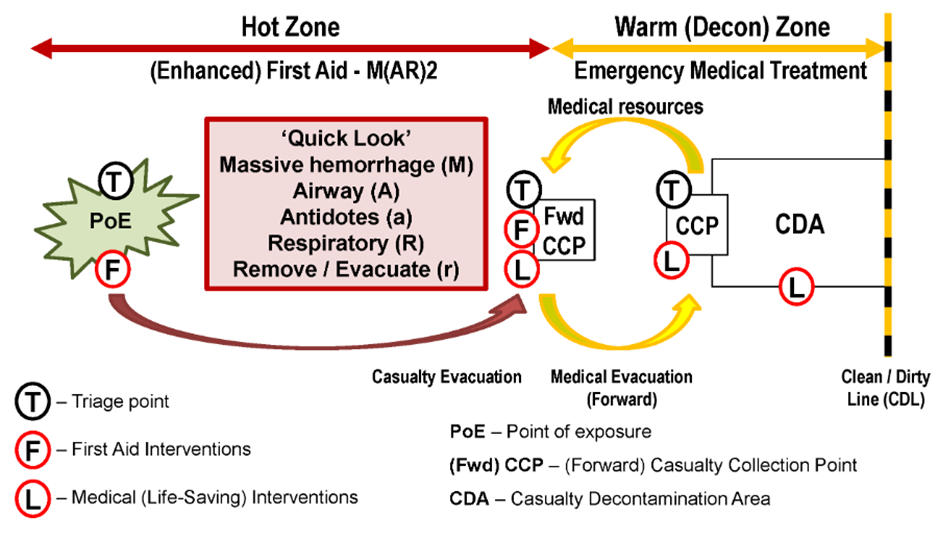
If in the HOT ZONE (this is equivalent to Care Under Fire in TCCC)
Use Quick look CRESS and use MAR2 (“MAR squared”) approach to identify nerve agent intoxication and immediate first aid interventions required.
M = Massive Haemorrhage and Mask (apply personal respirator)
A = Airway and Antidotes (nerve agent T1=Combopen)
R = Respiratory and Remove (spot decon and evacuate)
Use basic airway manoeuvres, head tilt chin lift, or jaw thrust if concurrent trauma.
If airway needs suctioning due to secretions, and kit available, use suction.
Evacuate in recovery position if possible, moving upwind, uphill, upstream from CW agent when tactical picture allows.
Role 1 in the WARM ZONE
Manage incident using S.C.3A.T.3E.R. approach – refer CBRN Med Slate Cards.
Prioritise LIFE SAVING INTERVENTIONS (treatment) for T1 casualties
TREATMENT of Nerve Agent patients:
T1 nerve agent patients should receive all THREE Combo-pens I.M. (2mg Atropine + 500mg Pralidoxime + 5mg Diazepam) immediately if:
confirmed nerve agent incident AND
patient has features consistent with nerve agent intoxication.
T2 nerve agent patients should receive ONE Combo-pen I.M. every 15 minutes as required.
Use “expose to treat” command if T1 features and team need to manage airway obstruction with jaw thrust / adjuncts.
Insert NPA, OPA, (IGEL as indicated by AVPU level) and manage secretions with suction as necessary.
Concurrent hazard management should be undertaken by SQEP/CDA personnel present (dry decontamination using Fullers Earth to adsorb liquid agent present on PPE), prior to PPE removal and wet decontamination of skin (if indicated for liquid agent).
If exposed to treat, administer high concentration oxygen (NRBM or via BVM onto IGEL) and establish IO/IV access.
Treatment goals
Patent airway, adequate oxygenation, ventilation and circulation:
Administer high dose Atropine to T1 patients: 5-10mg IV/IO (Combopens if used contribute to this) to antagonise Cholinergic and Nicotinic Acetylcholine Receptor excess activation.
Stop seizures if patient is fitting with 5mg IV/IO Diazepam OR Midazolam, before administration of oxime loading.
Administer the antidote: the adult loading dose of pralidoxime is 2g IV / IO given over 5 minutes. (Combopens each contribute 500mg IM to this pralidoxime loading dose).
Reverse the '3Bs' - Bronchospasm, Bronchorrhoea, Bradycardia:
If signs of continuing nerve agent toxicity give further doses of Atropine 5mg IV / IO every 5 minutes.
Consider serial doubling of high Atropine dose if continuing nerve agent toxicity.
If further doses of Atropine required, consider use of Hyoscine HYDRO-bromide (HHB) 0.8mg to 2.4mg IV / IO especially if Atropine high concentration ampoule supply is limited or not available (0.8mg HHB = 10mg Atropine).
Note HHB is the centrally active compound and is NOT equivalent to hyoscine butylbromide (Buscopan).
HHB can have pronounced sedative effects but counteracts the central excitatory effects of excess acetylcholine seen in severe nerve agent intoxication.
Clinical goal is for ‘atropinisation’ (absence of ‘3Bs’), HR >80, SBP >80, flattening of ETCo2 waveform.
Atropinisation is likely to occur more quickly if serial doubling approach is taken.
This may also avoid need for intubation and ventilation. Ensure this total Atropine dose is recorded for the ATMIST-D handover.
If further seizures treat with diazepam or midazolam 5mg IV / IO and consider further anti-convulsant drugs (Keppra) if available.
If continuing airway protection is needed or nerve agent seizures resistant to treatment occur, consider IGEL insertion and request L8 provider / MERT for PHEA.
Advanced Assessment & Management
ADVANCED MEDICAL CARE (Role 2 / 3)
Confirm ATMIST-Decon state using Chemical Agent Monitor prior to admission to MTF.
Reassess CRESS and buddy aid / treatment given at Role 1.
Airway:
If I-gel placed at Role 1 and continuing requirement for airway protection invasive oxygenation/ventilation support, then plan for intubation with Ketamine 0.5-1mg/kg AND 2mg/kg Rocuronium. (Increased dose of Roc likely required due to excess ACh in NMJ). Avoid Suxamethonium.
If excessive secretions, prepare for difficult intubation and utilise VL with 2x high volume suction.
Prepare for difficult intubations as per relevant SOPs.
Breathing:
Ventilation is likely to be complicated by bronchospasm leading to hypercapnia, high airway pressures and gas trapping.
Lung protective ventilation (Paw <30cmH2O, VT 4-6ml/kg, Fio2 titrated to achieve Spo2 94-98%, with permissive hypercapnia ETCo2 < 8KPa) strategy with a I:E ratio of 1:3-1:5 may be required.
Monitor blood gases as required using iSTAT CG4 (pH pCO2 pO2 and lactate).
Short term Rocuronium infusion 0.5mg/kg/hr may be protective of the NMJ and aid ventilation.
Note Brochorrhoea / Bronchoconstriction may superficially mimic appearance of tension pneumothorax.
Atropinisation
If signs of continuing ‘3Bs’ nerve agent toxicity (bronchospasm, bronchorrhoea (excessive secretions) and bradycardia, give further doses of Atropine 5mg IV / IO every 5 minutes. Consider serial doubling of Atropine dose if continuing nerve agent toxicity seen.
If further doses of Atropine required, consider use of Hyoscine HYDRO-bromide (HHB) 0.8mg to 2.4mg IV / IO especially if Atropine high concentration ampoule supply is limited or not available (0.8mg HHB = 10mg Atropine).
Once atropinisation is achieved, maintenance Atropine infusion mg/hr dose equals 10-20% the total Atropine required to achieve atropinisation (flattening of capnography trace, warm dry skin, drying of bronchial secretions, absent bowel sounds, urinary retention if not catheterised).
Oxime infusion
Maintenance Pralidoxime infusion is 8mg/kg/hr.
It may be possible to access to point of care %-Plasma acetylcholinesterase inhibition monitoring via reachback discussion with DSTL / DCA CBRN.
Alternative oxime is obidoxime. 4mg/kg loading dose then 0.5mg/kg/hr infusion.
Circulation:
Paradoxical tachycardia and hypotension can be seen if excessive nicotinic ACh activation occurs with nerve agent intoxication. This has been seen with GB (Sarin) inhalation.
Relative tachycardia will also be expected secondary to anti-cholinergic effects of atropine on sino-atrial node.
Fluid losses from urination, defecation, and bronchorrhoea can accumulate and require crystalloid fluid replacement IO/IV to maintain neutral fluid balance.
Percutaneous lines will likely need to be sutured in place.
Use vasoactive infusion to maintain adequate MAP as required.
Monitor urea and electrolytes using CHEM-8 iSTAT testing as required to guide electrolyte.
Maintain high normal Magnesium level for bronchodilatation and pre-synaptic neurone stabilisation (calcium antagonism results in lessened ACh release).
Disability
If available, monitor pEEG to confirm absence of status epilepticus.
Maintain deep sedation with Propofol infusion 1-4mg/kg/hr (GABA agonist)
OR Ketamine infusions 0.5-2mg/kg/hr (NMDA antagonist, neuroprotective, bronchodilatation, sympathomimetic effects) and Midazolam 0.05mg/kg/hr infusion.
Consider loading with 30mg/kg Keppra for centrally acting anticonvulsant effects.
Prolonged Casualty Care
It is highly likely that severely intoxicate nerve agent casualties will not survive prolonged periods of time without effective medical care.
This is particularly true when nerve agent exposure is combined with traumatic injury.
Suggested order of priorities when the OPCP is ineffective:
1. Reduce dose exposure through prompt and effective decontamination.
2. Early and full administration of oximes is critical to counter-act the effect of 'ageing' (the irreversible binding of nerve agent to acetylcholine esterase).
3. Give as much atropine as possible early to reverse the effects - this may reduce ongoing requirements for oxygen and other medical support
4. Maintain oxygen levels as close to normal as possible
5. Be prepared for large volume losses through sweating/seizures/secretions and replace in whatever way possible
Paediatric Considerations
Children are disproportionately affected by nerve agent exposures for a number of reasons.
Their short stature means they are potentially exposed to higher concentrations of vapour/aerosol as these are generally heavier than air.
Their higher surface area:body volume ratio means percutaneous exposure has a disproportionate effect.
The treatment approaches are the same, noting the following:
Atropine - atropinisation is also directed by the 3Bs, but the desirable range will vary according to the child's age and size. Aim for normal values of heart rate, respiratory rate and an absence of wheeze.
Oxime - the loading dose for Pralidoxime is 40mg/kg, and the infusion follows the same principles as in adults (8mg/kg/hr).
TRIAGE patients using the CBRN triage sieve
IC passes updated METHANE/CBRN1 report when able.
T1 – Immediate - Nerve Agent patients have one or more of:
- obvious respiratory distress
- respiratory rate less than 10 or greater than 30 breaths/min,
- Or are unconscious and or fitting.
T2 - Urgent - Nerve Agent patients have one or more:
- walking AND features of nerve agent intoxication (these are confusion or excessive secretions or, HR<40)
OR
- unable to walk, with normal RR (>10 <30) and NO resp distress.
- NOT unconscious.
- NOT convulsing.
T3 – Delayed
- Walking AND without signs of nerve agent intoxication (these are confusion, excessive secretions and HR <40)
Prioritise only LIFE SAVING INTERVENTIONS (treatment) to T1 casualties