
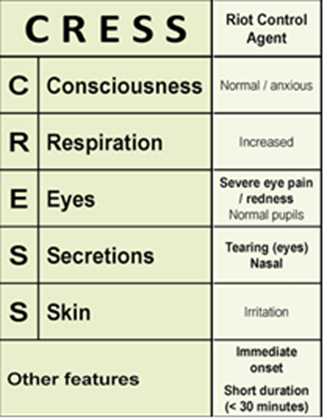
Riot Control Agents
Warning
Objectives
To guide the management of patients who have been exposed to Riot Control Agents (RCA).
RCA are irritants characterised by a very low toxicity, rapid onset and a short duration of action. In general, these agents have a very wide margin of safety. RCA are permitted for law enforcement but prohibited from use as a method of warfare.
Scope
This guideline describes the management of patients exposed to RCA in a forward medical context or deployed Emergency Department and includes a quick reference graphic as an aide-memoire.
The main group of RCA are lachrymators such as: CS (tear gas); CN (mace spray); OC (pepper spray). There are also other less frequently used lachrymators such as CR ((dibenz[b,f][1,4]oxazepine); PS (chloropicrin) and CA (bromobenzyl cyanide).
Audience
This guideline is intended for the use of registered healthcare professionals fulfilling a general role in a forward medical location or in an Emergency Department on deployed operations.
Initial Assessment & Management
Safety
Personnel treating CBRN casualties must ensure their own safety first by applying appropriate IPE/PPE and being aware of the tactical situation, addressing any immediate risks to life.
If a CBRN agent is suspected, then a CRESS (see below) or CBRN ‘Quick Look’ should take place to try and identify the causative agent during initial assessment.
There are no specific antidotes for the treatment of RCA.
Casualties and responders should apply GSR/ respiratory protection as per Immediate Action drills, if the casualty has not already been decontaminated or is in the hot or warm zone. If the casualty is incapacitated/obtunded, the responder should apply their IPE for them as required.
Massive Haemorrhage
External haemorrhage due to trauma should be controlled with tourniquets, haemostatic gauze and dressings as appropriate. If previously applied, they should be rechecked for efficacy/ need. They will require changing if applied prior to the Clean-Dirty- Line (CDL) during decontamination.
Airway and antidotes (MedCM)
There should be no requirement for airway management in isolated RCA exposure at standard concentrations. If there is airway or ventilatory compromise due to very high dose exposure (e.g. enclosed space with high concentration exposure), chloropicrin use, or other aetiology then airway management, up to and including SGA should be considered prior to the Clean-Dirty- Line (CDL) where full decontamination will take place. Definitive airway interventions such as endotracheal intubation should only be considered thereafter. There are no specific antidotes for RCA exposure.
Respirations
The first symptom of RCA exposure is a burning sensation in the throat, developing into pain and extending to the trachea and bronchi. At a later stage a sensation of suffocation may occur, often accompanied by fear. In addition a burning sensation in the nose, rhinorrhoea, erythema of the nasal mucous membranes and sometimes mild epistaxis occurs. The sense of taste is often distorted for some hours after exposure. Sneezing occurs after mild exposure and may be persistent.
There should be no requirement for respiratory support in the case of isolated RCA exposure at standard exposure concentrations. Respiratory interventions may be required to address the effects of a very high concentration of RCA and in chloropicrin use (see pulmonary agent CGO) as they may cause pulmonary oedema.
Treat other causes of respiratory compromise, such as trauma e.g. tension pneumothorax or medical e.g. exacerbations of asthma as per standard protocols, but avoid complex interventions such as formal chest drain insertion until full decontamination has taken place.
Circulation
There should be no requirement for circulatory support in the case of isolated RCA exposure at standard exposure concentrations. Circulatory compromise due to another aetiology should be assessed and treated as per standard protocols.
Head Injury / Hypothermia & Decontamination
Where possible and depending on the tactical situation, exposed persons should move to fresh air, separate from other contaminated personnel, and face into wind with eyes open and breathe deeply. Contaminated eyes and skin should be flushed with copious amounts of water. If a residue is found on equipment or clothing, personnel should change and wash their clothing.
Eye symptoms include a violent burning sensation, conjunctivitis (lasting up to 30 mins), erythema of the lids (lasting 1 hour), blepharospasm, lacrimation (over 20-15min) and photophobia. Nausea, diarrhoea and headache have been observed.
If large particles or droplets have entered the eye, treat as for corrosive materials and irrigate with copious amounts of water. Skin may be washed with soap and water and clothing changed.
There should be no change in conscious level in isolated RCA exposure.
Many exposed patients have reported fatigue for some hours afterwards.
In the event of an altered conscious level or seizures, seek and address aetiologies other than RCA exposure.
There should be no requirement for thermoregulatory support in the event of isolated RCA exposure, however, remain vigilant to the risk of hyperthermia due to IPE use and hypothermia due to wet decontamination.
There should be no need to evacuate a casualty exposed to RCA in isolation who have no ongoing symptoms once they have recovered and are decontaminated.
Advanced Assessment & Management
RCAs are irritants characterised by a very low toxicity, rapid onset and a short duration of action. There should be no long acting or significant health affects from these in isolation. If patient is critically unwell then causes other than RCA exposure should be sought and treated in their normal manner.
Prolonged Casualty Care
Supportive measures until effects have worn off.
Paediatric Considerations
As per adult and drug dosing iaw page per age