Priapism

Warning

Objectives

  • To guide the assessment and management of patients presenting to medical facilities with priapism 
  • Provide advice on immediate to short term management of patients with priapism 
  • Identify red flag signs/symptoms to aid triage for transfer to onward specialty care 


Scope

This guide aims to aid clinicians not specialised in urology in the initial assessment, investigations and management of priapism and the onward referral of patients in which this initial management proves unsuccessful. 

Audience

This guideline is intended for the use of registered healthcare professionals fulfilling a general role in a forward medical locations or in an Emergency Department on deployed operations. 


Initial Assessment & Management

Priapism is defined as prolonged penile erection (>4 hours) that persists without sexual stimulation/despite orgasm.

Initially take a history (including duration) and examine (penis, abdomen and neurological) in order to determine if ischaemic or non-ischaemic.

Ischaemic (low flow) – more common and treatment is emergent. Painful, pain increasing with duration of priapism. Erection sparing the glans. 

Non-ischaemic (high flow) – less common. Painless/uncomfortable. 

If in doubt, manage as ischaemic priapism, as below  

Ischaemic priapism 

Ensure adequate analgesia and administer broad spectrum antibiotics as per guidelines. 

If possible, provide a dorsal penile nerve block by injecting local anaesthetic (10 mL of 1% lidocaine without adrenaline) at the dorsum of the base of the penis (details of technique in accordion content). 

Undertake corporeal aspiration and washout (see accordion content)

Non-ischaemic priapism

No emergency intervention required but will require specialist input for definitive management.

Note that priapism in the context of spinal shock or injury is non-ischaemic and requires no emergency treatment.

Advanced Assessment & Management

Investigations 

Corporeal blood gas analysis of aspirate – hypoxaemia, acidaemia and glucopenia is diagnostic of ischaemic priapism. Normoxia, correlating with clinical findings can point towards non-ischaemic priapism but this should be confirmed with Doppler

Bloods may be useful including FBC, electrolytes, clotting, bloods for screening sickle cell disease.

Ultrasound (penile Doppler). There will be no flow in cavernous arteries in ischaemic priapism.

Ultrasound scanning must not delay intervention if ischaemic priapism suspected

Management 

For ischaemic priapism, if corporeal aspiration and washout fails twice, instil phenylephrine:  

  • Dilute 1 mL of phenylephrine (10mg/mL) in 9 ml of saline using 10 mL syringe 
  • Instil 1 mL (500 mcg) aliquots, using the already inserted needle  
  • Ensure adequate blood pressure monitoring throughout
  • Repeat every 10 minutes up to a dose of 1500 mcg (3 aliquots) 

If this still fails to achieve detumescence or priapism prolonged (>24 hours), the patient will require specialist surgical input  


Paediatric Considerations

Management of paediatric priapism will follow the same principles. Seek specialist advice as early as possible.

Note that phenylephrine dosing should be adjusted to aliquots of 100 mcg. 

Detailed Assessment & Management Guidance

Definition

Prolonged penile erection (>4 hours), continues without sexual stimulation and despite ejaculation/orgasm.

Classification

Ischaemic (low flow) – more common. Painful due to ischaemia, with pain increasing with the duration of the priapism. Caused by venous outflow obstruction/thrombosis. Presents as rigid erection sparing the glans. If persists >12 hours, priapism can lead to permanent fibrosis and calcification. Causes: idiopathic, haematological (eg sickle cell disease) and medication (vasoactive erectile agents, antipsychotics, anticoagulants, antidepressants, anti-hypertensives, hormone therapy).

Non-ischaemic (high flow) – less common. Painless or only uncomfortable with no risk of necrosis. Normally secondary to trauma, unregulated inflow due to rupture of cavernosal artery.

Rarer subtypes:

  • Recurrent/stuttering – more common in sickle cell disease patients. Frequent prolonged and painful erections. Treatment involves oxygenation, hydration, analgesia and possible exchange transfusion.
  • Priapism in spinal shock – occurs in spinal injury with loss of sympathetic tone leading to high-flow, non-ischaemic priapism. Requires no treatment.

If in doubt, manage as ischaemic priapism

Clinical History

If possible, establish and document

  • Duration of erection (<48 hours, 48-72 hours, >72 hours)
  • Any underlying haematological disorder
  • Current medication
  • Illicit drug use
  • Symptoms to suggest pelvic malignancy
  • Previous episodes
  • Recent perineal/penile trauma
  • Neurological symptoms

Examination

  • Penis – look for evidence of sparing of the glans and trauma
  • Abdomen and DRE – look for evidence of underlying pelvic malignancy
  • Neurological – evidence of spinal cord injury

Investigations (if available)

  • Bloods – FBC, electrolytes, clotting, blood smear/sickle cell screen
  • Urine and blood toxicology if recreational drug use
  • Penile bloods gas from first aspirate to help differentiate ischaemic (pH <7.25, pCO2 >8 kPa, pO2 <4 kPa) and non-ischaemic priapism but normoxia does not exclude ischemic priapism.
  • Imaging
    • US penile doppler
    • Abdominal and pelvic CT/MRI – penile MRI can be used to assess viability of corpus cavernosum in refractory cases

Management

Ischaemic – for patients with prolonged priapism or priapism that proves refractory to the above interventions, Urology specialist input is required for surgical shunt formation and consideration of early penile prosthesis insertion

Non-ischaemic – manage conservatively. If does not spontaneously resolve, will need specialist intervention in a unit that can offer super selective arteriography and embolization.

Follow up

All patients will need specialist follow-up to monitor for late-onset erectile dysfunction
Technique: Corporeal Aspiration and Washout

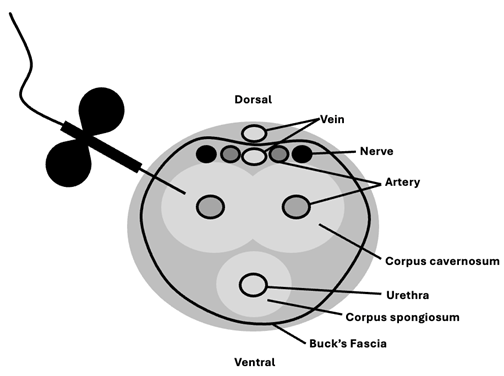
Insert a large 19-gauge needle or butterfly needle into lateral aspect of one corpus cavernosum, at the 2 or 10 o’clock position 

Aspirate and wash-out to achieve detumescence – remove 10-15 mL of static blood and replace with saline until aspirate is bright red or detumescence is achieved. Expect to aspirate 200-300 mL.  

If fails or returns, repeat once

If fails or returns again, evacuate patient without delay for further management.


Technique: Dorsal Penile Block

Preparation: Position patient supine, clean area of gross contamination/debris, apply skin prep (chlorhexidine or povidone-iodine solution) to suprapubic region, penis, and scrotum. Apply sterile drape to area.

Inject small volume of local anaesthetic to skin in the midline at the dorsum of base of penis with small gauge needle to raise bleb of local anaesthetic (LA, typically lidocaine 1%, without adrenaline).

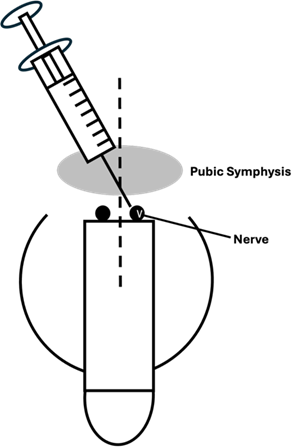
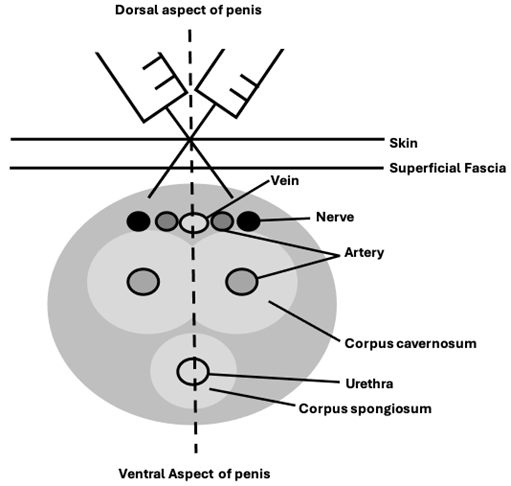
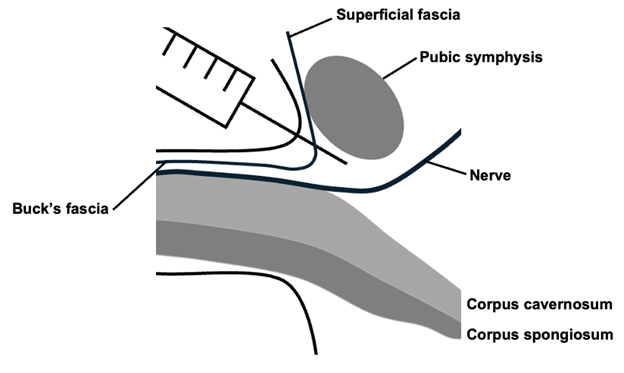
Insert a larger gauge needle, perpendicular to the skin, via the anaesthetic bleb, and advance it until it touches the pubic symphysis. Withdraw the needle slightly and adjust to pass it below the pubic symphysis, aiming it slightly laterally by around 20o, and advance approximately a further 3 to 5 mm.

Attempt to aspirate to ensure the needle is not in a blood vessel. Inject LA (c. 10 mL), there should be very little or no resistance.

Repeat on the contralateral side taking care to withdraw the needle to the bleb before advancing again to prevent inadvertent damage to midline structures (suspensory ligament and blood vessels).


Figure 1: Needle is inserted in midline and advanced 3- 5mm to pass below pubic symphysis on each side.

Figure 2: Cross section of penile anatomy. Needle inserted at midline and LA applied at depth of 3-5 mm bilaterally. 

Figure 3: Sagittal section of penile anatomy. Needle inserted at midline, angled 20o laterally and advanced 3-5 mm to pass below pubic symphysis

Last reviewed: 27/01/2026

Next review date: 27/01/2027

References

BAUS Section of Andrology Genitourethral Surgery, Muneer A, Brown G, et al. BAUS consensus document for the management of male genital emergencies: priapism. BJU Int. 2018;121(6):835-839. doi:10.1111/bju.14140

Priapism - Symptoms - Emergency Management. TeachMeSurgery. Accessed May 19, 2025. https://teachmesurgery.com/urology/other/priapism/

McPhee AS, McKay AC. Dorsal Penile Nerve Block. In: StatPearls. StatPearls Publishing; 2025. Accessed May 21, 2025. http://www.ncbi.nlm.nih.gov/books/NBK535389/

Priapism, Plymouth Hospitals ED Clinical Guidelines, Horne, reviewed April 2017

Clinical Procedure for the Management of Priapism, Norfolk and Waveney Acute Hospital Collaborative, H Hussein, October 2024