The app and website was publicly released on 2 Apr 2024
Update Jan 2025
The content continues to undergo review by all our cadres.
The content remains subject to the following provisos: - The content will be subject to continuous update and review - Old content (from previous CGOs) will be converted into the new format, using the new tools and layouts - Content may be moved around - The layout will change and reflect the needs of the user - Content will be created - Content may be deleted/retired
CGO development will continue.
Saf [Updated 21 Jan 2025]
Asthma
!Warning
Objectives
To outline the expected management of Asthma in the operational environment.
Scope
This Guideline covers diagnosis and management in Role 1-3 settings including intensive care of adults with asthma. Consideration is also given to paediatric patients.
This guideline covers clinical diagnosis, assessment of severity, management (initial and prolonged), and differential diagnosis of acute asthma exacerbations. Consideration is given to special circumstances of pregnancy and paediatric patients.
Audience
This guideline is intended for use by registered healthcare professionals fulfilling a general role in forward medical locations or in an emergency department in a deployed hospital setting.
Initial Assessment & Management
Background
Asthma is a chronic respiratory condition which may present in the deployed setting in personnel with a known diagnosis or de-novo, with a wide range of symptom severity; from cough and exercise intolerance to a potentially life-threatening acute exacerbation. The operational setting poses significant potential to exacerbate asthma through the combination of physical degradation and vulnerability to infection, climatic extremes, increased rates of smoking and vaping, NSAID use for musculoskeletal injuries, along with occupational exposure to allergens and triggers ranging from sensitisers such as epoxy resins and irritants such as chemicals and solvents used in munitions. The commonality of asthma, typically with milder symptoms, must not falsely reassure clinicians in this setting, for there remains a risk for symptoms to deteriorate rapidly and un-predictably. This said, simple and highly effective treatment exists which will mitigate the vast majority of this risk if used correctly. For ease and reliability of delivery, Fostair NEXThaler is the recommended treatment in most patients.
Asthma is a clinical diagnosis supported by objective tests. Cardinal symptoms include expiratory wheeze, breathlessness, chest tightness and cough. When deployed, access to diagnostic testing including FeNO, blood eosinophils and spirometry will not be available, placing even more emphasis on an accurate history. For patients without a pre-existing formal diagnosis of Asthma but with symptoms of an acute exacerbation of asthma, treatment should be initiated and formal diagnostic testing conducted when recovered.
Initial Assessment
Diagnosis of an acute asthma exacerbation is made based on clinical symptoms supported by peak flow testing. In the absence of a peak flow meter, clinical features described below are highly descriptive of severity.
An acute exacerbation of asthma should be categorised based on severity of symptoms. (see Table 1). This will guide medical interventions, appropriate timelines for Medevac if required and the selection of an appropriate medical facility for ongoing care. Whilst symptoms and observations should be prioritised, objective testing with blood gas (if available) and peak flow should be considered to guide treatment and monitor response.
Moderate acute Asthma
Acute severe asthma
life threatening asthma
Near fatal Asthma
Increasing symptoms
PEF 33-50% best (last 2 years) or predicted
SpO2 <92% plus any one of the following in a patient with severe asthma:
Raised PaCO2 and/or requiring mechanical ventilation with raised inflation pressures
No features of acute severe asthma
Heart rate ≥110/min
PEF <30% best or predicted
Inability to complete full sentences
high PaCO2 (4.6–6.0 kPa)
PEF: Peak expiratory flow. This should be expressed as a percentage of the patient’s previous best value within the last 2 years. If this is not known then age adjusted values should be used. Age adjusted values can be found in CGO toolbox ‘Asthma Peak Flows’.
Previous admissions to hospital and particularly those with previous near fatal asthma suggest a patient at high risk for deterioration. If present, care should be escalated to setting with Critical Care capability.
Differential diagnosis
Consideration should be given to asthma mimics or co-diagnoses, including Anaphylaxis, Inducible laryngeal obstruction, Breathing Pattern Disorders, and cardiac causes (see Differential Diagnoses section).
Initial management in Role 1
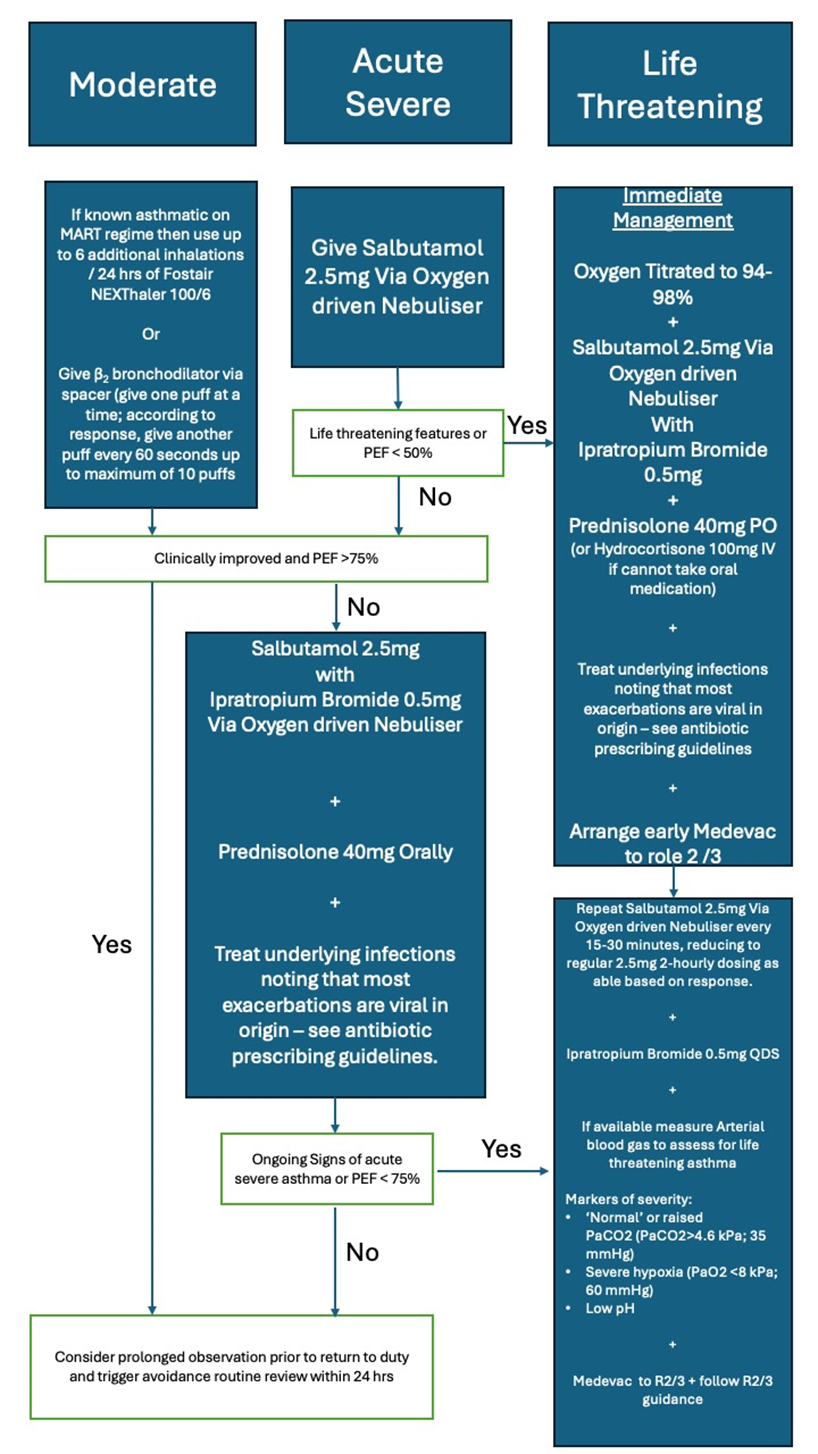
Management of moderate acute asthma:
If known to be asthmatic and on a MART (Maintenance and reliever therapy - where a LABA/ICS inhaler is used both for maintenance and for acute symptom relief) regime then use up to 8 additional inhalations / 24 hrs of Fostair NEXThaler 100/6 (total 12 inhalations / 24hrs)
or
Inhaled salbutamol 100mcg delivered via spacer – 100mcg Salbutamol inhaler via spacer given one puff at a time, inhaled separately using tidal breathing; according to response, give another puff every 60 seconds up to a maximum of 10 puffs.
Prednisolone 40mg OD until recovered (min 5 days) and continue inhaled corticosteroids
Treat underlying infections – noting that most exacerbations are viral in origin. see antibiotic prescribing guidelines.
If not improving then escalate to management as per acute severe asthma.
Management of acute severe asthma
Medevac to Role 2/3
Oxygen titrated to target SpO2 92-96%
Nebulised salbutamol 2.5mg. Give further nebulised salbutamol Every 15-30 minutes if required.
Prednisolone 40mg OD until recovered (min 5 days) and continue inhaled corticosteroids
Ipratropium Bromide 0.5mg Stat then QDS if not improving with salbutamol.
Treat underlying infections noting that most exacerbations are viral in origin – see antibiotic prescribing guidelines.
If PEF < 50% despite nebulised salbutamol, then treat as per ‘Life Threatening asthma’.
Management of life-threatening asthma
Medevac to Role 2/3
Oxygen titrated to target SpO2 92-96%
Nebulised salbutamol 2.5mg (preferably oxygen driven). Give further nebulised salbutamol if required immediately, then every 15-30 minutes if required. Reducing to regular 2.5mg 2-hourly dosing as able based on response.
Nebulised Ipratropium 0.5mg STAT then QDS weaned as able based on response.
Prednisolone 40mg OD until recovered (min 5 days) and continue inhaled corticosteroids
Consider pneumothorax - unilateral no air entry, no chest movement, hyper-resonant percussion. If skillset and equipment available, POCUS may help support the clinical diagnosis.
Treat underlying infections noting that most exacerbations are viral in origin – see antibiotic prescribing guidelines.
Obtain ABG if available, assessing for markers of severity.
‘Normal’ or raised PaCO2 (PaCO2>4.6 kPa; 35 mmHg)
Severe hypoxia (PaO2 <8 kPa; 60 mmHg)
Low pH
Early liaison with senior support after starting initial treatment
Nebulised Salbutamol dose – Note that Salbutamol 2.5mg via a nebuliser is as effective as 5mg with a reduced side effect profile (tachycardia, tremor, hypokalaemia, lactatemia). Further salbutamol can be given if required but an initial 2.5mg dosing should be used and continued once stabilised.
Discharge
Consider discharge when symptoms have resolved, there is no longer wheeze and PEFR has returned to at least 75% of baseline, a minimum of 4 hours after the last nebuliser. If multiple nebulisers were required patient should be observed for a minimum of 12 hours post-last nebuliser.
Circadian pattern: Asthma symptoms are often more prominent at night or in the early hours. Do not be overly reassured by the apparent resolution of symptoms in the afternoon. Patients should be kept in a place of safety for monitoring for at least 24 hours.
Advanced Assessment & Management
Initial management in Role 2 and 3
Initial ROLE 2/3 management should follow Role 1 management with consideration given to treatment already delivered in Role 1.
Additional investigations available in R2/3 including ABG, routine bloods (including FBC, CRP, U+Es and LFTs), as well as a Chest X-ray should be conducted.
ABGs should be repeated within 1 hour of initiating treatment if:
The initial PaO2 is <8 kPa unless SpO2 is >92%; or
The initial PaCO2 is normal or raised; or
The patient’s condition deteriorates.
Potassium monitoring should be conducted with ongoing salbutamol use.
The following should be considered in R2/3 if the patient has not improved or deteriorates after initial nebulised bronchodilators and oral steroids.
Magnesium sulphate (1.2–2 g IV infusion over 20 minutes) used following consultation with senior medical staff in those with PEF <50% after initial treatment or symptoms not responding to initial treatment in Life threatening asthma.
Involve Intensive Care early
IV hydrocortisone 100mg QDS can be given in-lieu of oral prednisolone if there are concerns about oral absorption
NIV should only be considered in an intensive care setting where escalation to intubation and mechanical ventilation can be performed. Whilst NIV may be beneficial in some patients (obese, known OSA) it also carries a risk of perpetuating dynamic hyperinflation and inappropriately delaying intubation. It should only be considered in special circumstances by experienced critical care clinicians.
IV Salbutamol should only be used by experienced clinicians and discussed with intensive care. There is limited evidence for additional bronchodilation compared to adequate nebulised therapy. If used, serum lactate and potassium should be monitored due to the risk of toxicity.
N.B - IV aminophylline has been removed from modules and does not form part of this treatment guideline. There is limited evidence for its effectiveness and with a narrow therapeutic window, dose adjustment and avoidance of toxicity it is extremely challenging in the deployed settings.
Critical Care management of asthma
Clinicians with advanced airway skills and experience in managing life threatening asthma should be involved early. Admission to intensive care is required in any patient with severe or life-threatening features who is deteriorating or fails to improve with inhaled corticosteroids and nebulised bronchodilator therapy.
Indications for admission to ITU in acute asthma
Deteriorating PEF
Persisting or worsening hypoxia
Hypercapnia
Arterial blood gas analysis showing acidaemia
Exhaustion, feeble respiratory effort
Drowsiness or confusion
The decision to intubate in asthma is clinical guided by observations:
Relative Indications
Absolute Indications
Increasing use of accessory muscles, switch to shallow rapid breathing
Unable to rouse
Progressive exhaustion
Impending respiratory failure with gasping or inability to speak
Reduced responsiveness
Pa02 < 8.0kPa & / or PaC02 > 6.5kPa
Severe hypoxaemia with maximal oxygen delivery
Cardiac or respiratory arrest
Silent chest
Induction carries significant risks of worsening hypoxia, difficulty ventilating and cardiovascular collapse. It should be noted that a timely decision reduces these risks. The guiding principle of ventilatory support is to avoid dynamic hyperinflation.
Pre-induction anxiolysis with ketamine (preferred) or midazolam has the potential to minimise ineffective tachypnoea contributing to dynamic hyperinflation.
Ketamine is suggested for its cardiac stability in addition to its potential bronchodilator effects.
Hypovolaemia is anticipated- commence IVI.
If bradycardic give small aliquots of dilute adrenaline
Select larger bore endotracheal tubes to optimise flow and aid with airway toileting
Rocuronium tends to be used, with repeat boluses (or NMBA infusion) to ensure ventilator compliance and synchrony
Suggested initial ventilator settings:
Pressure controlled ventilatory modes are preferred
Respiratory rate 10/min (Range 8-14/min)
Inspiratory time to 0.8 sec, inspiratory flow 80L/min
I:E 1:3 - 1:5.
PEEP 0-3 cmH20
Tv 6-8ml/kg (accept 4ml/kg)
Adequacy of ventilation strategy can be assessed by monitoring expiratory flow graphs and lung compliance trends. If dynamic hyperinflation is suspected (hypotension, reduced compliance) either;
Disconnect from ventilator and perform manual decompression.
Or, perform 30-60 sec apnoeic pause
Hypotension not improved by addressing dynamic hyperinflation
Rule out pneumothorax
Consider myocardial impairment / ischaemic event.
Matching extrinsic PEEP to measured intrinsic PEEP (from an expiratory hold manoeuvre) has the theoretical benefit of improving compliance, but response is highly individualised. Normally ePEEP is kept below iPEEP.
High peak airway pressures are expected and should be tolerated, with driving pressures guided by plateau pressure (Pplat) (measured during an inspiratory hold manoeuvre) targeting < 30cmH2O.[5]
Refractory bronchoconstriction
Ketamine infusion (0.5-2mg/kg/hr. Should be weaned over 6 hours to prevent recrudescence)
Consider a trial of inhalational anaesthetics (this will necessitate transfer to theatre as no alternative gas scavenging equipment is contained in modules, and will therefore depend on utilisation rates of theatre and a resource utilisation discussion)
Exclude mucus plugging: trial NAC or hypertonic saline as a mucolytic, and attempt to clear via NBAL.
Options for evacuation for VV-ECMO in patients refractory to standard therapies should be considered early.
If easy to ventilate, the patient is unlikely to have had near life threatening asthma. Alternative diagnoses such as ILO become more likely, and early extubation could should be attempted. If rapid extubation successful, thought should be given to the management of future episodes.
Prolonged Casualty Care
Operational requirements may lead to prolonged care of acute asthmatics who have responded well to initial therapy.
Bronchodilator therapy – Salbutamol nebulisers should be continued initially at 2 hourly intervals, weaned promptly to QDS and then as required. Frequency can be re-escalated if wheeze or other symptoms return. Ipratropium should remain at 0.5mg QDS and then stopped when salbutamol switched to PRN.
Steroids – Prednisolone 40mg OD should continue until symptoms have improved and for at least 5 days. If a patient has received a prolonged course of steroids (> 2 weeks) then these should be tapered at 5mg every 3 days. Inhaled maintenance steroids should be continued.
Observations – conduct routine observations initially every 15-30 minutes reducing to hourly then four times a day if the patient remains stable. Routine observations should include Peak flow.
Blood glucose should also be monitored due to the effect of both beta-agonists and steroids in increasing blood glucose.
In patients who initially respond to treatment but subsequently acutely deteriorate despite regular nebulised treatments, pneumothorax must be ruled out. If clinical signs or symptoms of tension pneumothorax decompress immediately.
Discharge from medical care
Discharge from Role 1 should be discussed with a senior if available via reach-back, and care should be taken to identify and prevent re-exposure to triggers. The operational environment is a high-risk environment for poorly controlled asthma and patients may benefit from a period away to ensure adequate treatment prior to return to duty.
Diurnal variation - Due to diurnal variation the period of observation should be extended to include overnight. Note patients with PEF <75% and higher diurnal variation are at higher risk of early relapse.
Asthma review - Prior to discharge an asthma review should be conducted including review of inhaled therapy ensuring technique and supply are adequate. Helpful videos are available at asthmaandlung.org.uk.
Following a single exacerbation in the deployed setting it is recommended all personnel are migrated to a Maintenance and Reliever Therapy (MART) regime using a Fostair® NEXThaler (beclomethasone/Formoterol) for the remainder of the deployment. A further asthma review should be conducted on return to their base until following deployment.
Trigger avoidance - It is important to identify triggers and advise on their avoidance or reduction.
Respiratory infections (viral or bacterial)
Airbourne irritants e.g smoke from burn pits, oils and metal dust from munitions
Cold or hot / humid air
Allergens including dust, pollen, animals.
Exercise
Petroleum, Oil, and Lubricants (POL), and Epoxy resins.
Other triggers for asthma include:
Allergic rhinitis: treat with nasal steroid and oral antihistamine
Gastro-oesophageal reflux disease: treat with BD PPI and Gaviscon / peptic at night.
Obstructive sleep apnoea, contributes to airway inflammation and GORD.
Pregnancy
Management of asthma is unchanged in pregnancy. Rapid initiation of treatment is essential to avoid maternal and foetal hypoxia including with Salbutamol, Ipratropium Bromide, oral steroids (prednisolone) and Magnesium. Maintenance therapy should be continued in pregnancy.
Check safety of other medications, particularly antibiotics. Doxycycline should be avoided in pregnancy.
Paediatric Considerations
Assessment of asthma in children under 5 is difficult. Other causes of respiratory distress should be considered in this age group given the most common cause for respiratory distress is viral infection leading to Bronchiolitis.
The differential diagnosis includes
Aspiration pneumonitis
Pneumonia
Tracheomalacia
Complications of underlying conditions such as congenital cardiac anomalies and cystic fibrosis
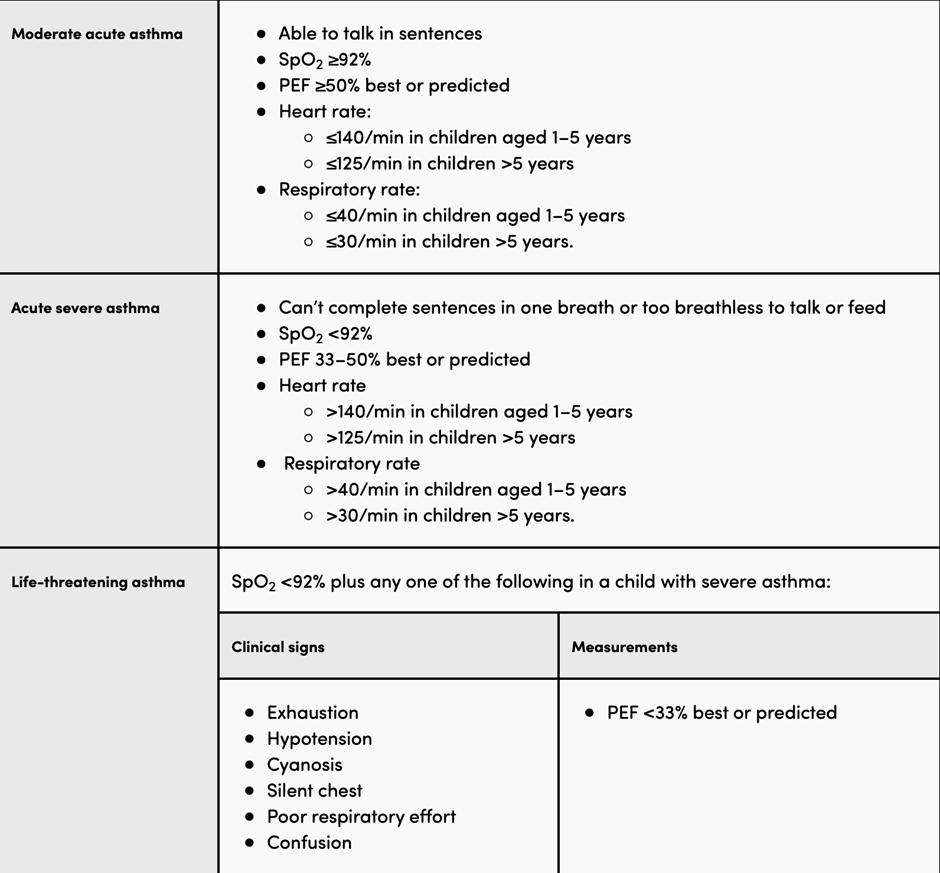
In children over 5 years old and/or where a diagnosis of asthma has been established the following can be followed. Special consideration is given to heart rate and respiratory rate values which vary with age.
Obtaining blood samples can be difficult. A normal PCO2 on a free flowing venous gas can be used to exclude hypercapnia.
Chest X-rays are used in life threatening asthma or where pneumonia or pneumothorax is clinically suspected.
Management
Early escalation to appropriate role throughout
Moderate acute asthma
2-5 Years
>5 Years
Salbutamol 100mcg inhaler via an appropriately sized spacer one puff at a time every 60 seconds up to 10 puffs
Salbutamol 100mcg inhaler via an appropriately sized spacer one puff at a time every 60 seconds up to 10 puffs
Oral Prednisolone 20mg
Oral Prednisolone 30-40mg
Acute severe asthma
2-5 Years
>5 Years
Oxygen titrated to SpO2 92-96%
Oxygen titrated to SpO2 92-96%
Salbutamol 2.5mg via oxygen driven nebuliser
Salbutamol 2.5mg via oxygen driven nebuliser
Oral Prednisolone 20mg
Oral Prednisolone 30-40mg
0.25mg Nebulised Ipratropium bromide (given with the salbutamol nebuliser)
0.25mg Nebulised Ipratropium bromide (given with the salbutamol nebuliser)
Life threatening asthma
2-5 Years
>5 Years
Oxygen titrated to SpO2 92-96%
Oxygen titrated to SpO2 92-96%
Salbutamol 2.5mg and Ipratropium Bromide 0.25mg via oxygen driven nebuliser – repeated every 20-30 minutes
Salbutamol 2.5mg and Ipratropium Bromide 0.25mg via oxygen driven nebuliser – repeated every 20-30 minutes
Oral Prednisolone 20mg
Oral Prednisolone 30-40mg
Escalate to available intensive care support / specialist paediatrics / PICU
If the patient fails to respond to therapy, reconsider the diagnosis before escalating treatment. For life threatening asthma not responding to initial treatment contact specialist reach back support as well as the following:
IV Magnesium 40mg/Kg (max 2g) over 20 minutes
IV Salbutamol 15micrograms/kg
If vomiting then give IV Hydrocortisone 4mg/kg 4 hourly instead of oral prednisolone.
Differential Diagnosis
Inducible laryngeal obstruction (ILO).
History would be of an hyperacute onset (seconds to minutes), accompanied panic, often to an identified trigger (including strong smells such as perfumes or chlorine or emotional stress). The patient would have a poor response to inhaled bronchodilators, and symptoms, whilst overlapping with asthma, feature throat rather than chest tightness and inspiratory stridor rather than predominantly expiratory wheeze. Resolution is often as rapid as onset, with no persisting symptoms.
A pure exercise form (EILO) is common in soldiers, predominantly occurring at higher intensity activity, consisting of cough and inspiratory difficulty, with full resolution of symptoms shortly after cessation of exercise (cf asthma, where symptom onset is more gradual, without an evident threshold effect and persist for longer after cessation (for several hours and often overnight).
Whilst outside the scope of in-theatre management, where treatment is conservative if the soldier is able to continue as before, treatment consists of exercises to regulate breathing, specific throat deconstriction techniques and attention to potential drivers of laryngeal sensitisation (chiefly GORD and PND).
A history of recurrent episodes of similar should provide reassurance that this is not anaphylaxis.
Anaphylaxis
History of exposure to allergen
Symptoms of lip, tongue and throat swelling in addition to shortness of breath
Hypotension and rapid deterioration to respiratory arrest
A maculopapular rash is often a late feature; absence of rash should not reassure
Manage as per anaphylaxis ALS algorithm
Breathing pattern disorder
It is not uncommon for patients to develop a breathing pattern disorder whilst deployed, often following an infection or related to stress.
Breathlessness predominates, classically with a description of inability to take satisfactory breath in. Breathing may be noted to be irregular, with periods of rapid shallow breathing or periodic large tidal volumes or sighs, with predominance of apical respiratory effort over abdominal or diaphragmatic.
PaCO2 if measured may be low due to chronic hyperventilation, with a respiratory alkalosis. This can contribute to chest tightness, paraesthesia (hands and peri-oral), and palpitations.
Cardiac
Cardiogenic wheeze due to pulmonary oedema is typically associated with other features of heart failure. A very rapid onset if associated with a raised JVP, loud pansystolic murmur or known valve pathology might reflect flash pulmonary oedema associated with advanced mitral valve disease. In the deployed setting this is unlikely, but there are no deployed diagnostic or treatment options and the patient will require repatriation if not fully responsive to simple therapies.
Environmental
Multiple cases presenting in a short time frame should raise concern of mass exposure to chemical irritants, eg. Chlorine gas or the spread of a viral infection including adeno and rhino-viruses, RSV, Influenza, whooping cough (Pertussus), and COVID-19.