
Diabetic ketoacidosis (DKA)
Warning
Objectives
Guide the safe management of DKA on Ops.
Scope
How do I diagnose and manage DKA?
Audience
This guideline is intended for use by registered healthcare professionals fulfilling a general role in forward medical locations or in an emergency department in a deployed hospital setting
Initial Assessment & Management
You may prefer the algorithm designed to print on a single side of A4, here
Glucose unit conversion
|
mmol/L |
mg/dL |
|
3.9 |
70 |
|
7.0 |
126 |
|
11.0 |
198 |
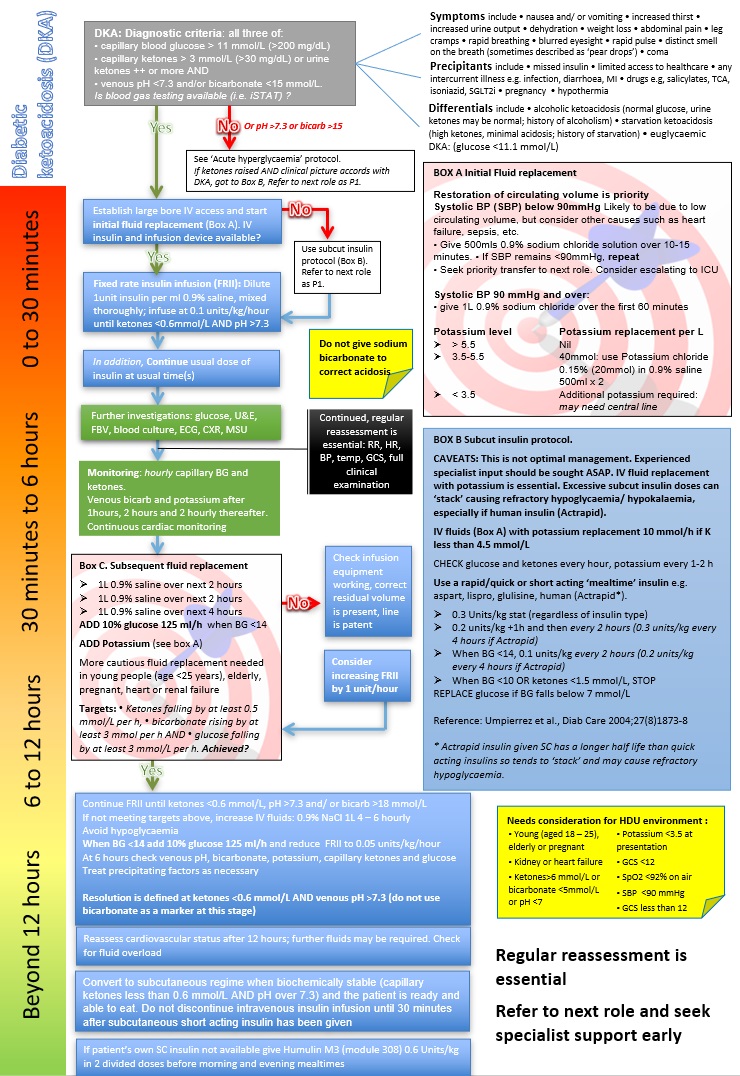
DKA diagnostic criteria: all three of
capillary blood glucose > 11 mmol/L (>200 mg/dL)
capillary ketones > 3 mmol/L (>30 mg/dL) or urine ketones ++ or more AND
venous pH <7.3 and/or bicarbonate <15 mmol/L.
If blood gas testing unavailable (i.e. no iSTAT) (Or pH >7.3 OR bicarbonate >15 mmol/L) See hyperglycaemia. If ketones raised AND clinical picture accords with DKA, see Subcut insulin protocol (below). Refer to next role as P1.
Establish large bore IV access and start initial fluid replacement: Hyperglycaemia
Restoration of circulating volume is priority
Systolic BP (SBP) below 90mmHg:
Likely to be due to low circulating volume, but consider other causes such as heart failure, sepsis, etc.
Give 500mls 0.9% sodium chloride solution over 10-15 minutes
If SBP remains <90mmHg:
repeat
Seek priority transfer to next role. Consider escalating to ICU
SBP 90 mmHg and over:
give 1L 0.9% sodium chloride over the first 60 minutes
Max 20mmol/hr without cardiac monitoring
| Potassium Level (mEq/L) | Potassium replacement |
| > 5.5 | Nil |
| 3.5-5.5 | 40mmol/L: use Potassium chloride, 0.15% (20mmol) in 0.9% saline, 500ml x 2, |
| < 3.5 | Additional potassium required: may need central line |
Is IV insulin and infusion device available?
- NO:, see Subcut insulin protocol and refer to next role P1.
- YES - start Fixed rate insulin infusion (FRII): Dilute 1unit insulin per ml 0.9% saline, mixed thoroughly; infuse at 0.1 units/kg/hour until ketones <0.6mmol/L AND pH >7.3
In addition, Continue usual dose of insulin at usual time(s)
Continued, regular reassessment is essential: RR, HR, BP, temp, GCS, full clinical examination
Advanced Assessment & Management
Further investigations: glucose, U&E, FBV, blood culture, ECG, CXR, MSU
Monitoring: hourly capillary BG and ketones.
Venous bicarb and potassium after 1 hour, 2 hours and 2 hourly thereafter. Continuous cardiac monitoring
Subsequent fluid replacement
- 1L 0.9% saline over next 2 hours
- 1L 0.9% saline over next 2 hours
- 1L 0.9% saline over next 4 hours
ADD 10% glucose 125 ml/h when BG <14
ADD Potassium (see section intial fluid management, above)
More cautious fluid replacement needed in young people (age <25 years), elderly, pregnant, heart or renal failure
Targets: • Ketones falling by at least 0.5 mmol/L per h, • bicarbonate rising by at least 3 mmol per h AND • glucose falling by at least 3 mmol/L per h. Achieved?
NO - Check infusion equipment working, correct residual volume is present, line is patent. If so, consider increasing FRII by 1 unit/hour
YES - continue to prolonged casualty care section
Prolonged Casualty Care
Continue FRII until ketones <0.6 mmol/L, pH >7.3 and/ or bicarb >18 mmol/L
If not meeting targets above, increase IV fluids, increase FRII by 1U/hr
Avoid hypoglycaemia
When BG <14 add 10% glucose 125 ml/h and reduce FRII to 0.05 units/kg/hour
At 6 hours check venous pH, bicarbonate, potassium, capillary ketones and glucose
Treat precipitating factors as necessary
Resolution is defined at ketones <0.6 mmol/L AND venous pH >7.3 (do not use bicarbonate as a marker at this stage)
Reassess cardiovascular status after 12 hours; further fluids may be required. Check for fluid overload
Convert to subcutaneous regime when biochemically stable (capillary ketones less than 0.6 mmol/L AND pH over 7.3) and the patient is ready and able to eat. Do not discontinue intravenous insulin infusion until 30 minutes after subcutaneous short acting insulin has been given
If patient’s own SC insulin not available give Humulin M3 (module 308) 0.6 Units/kg in 2 divided doses before morning and evening mealtimes
Symptoms include • nausea and/ or vomiting • increased thirst • increased urine output • dehydration • weight loss • abdominal pain • leg cramps • rapid breathing • blurred eyesight • rapid pulse • distinct smell on the breath (sometimes described as ‘pear drops’) • coma
Precipitants include • missed insulin • limited access to healthcare • any intercurrent illness e.g. infection, diarrhoea, MI • drugs e.g, salicylates, TCA, isoniazid, SGLT2i • pregnancy • hypothermia
Differentials include • alcoholic ketoacidosis (normal glucose, urine ketones may be normal; history of alcoholism) • starvation ketoacidosis (high ketones, minimal acidosis; history of starvation) • euglycaemic DKA: (glucose <11.1 mmol/L)
CAVEATS: This is not optimal management. Experienced specialist input should be sought ASAP. IV fluid replacement with potassium is essential. Excessive subcut insulin doses can ‘stack’ causing refractory hypoglycaemia/ hypokalaemia, especially if human insulin (Actrapid).
IV fluids (Box A) with potassium replacement 10 mmol/h if K less than 4.5 mmol/L
CHECK glucose and ketones every hour, potassium every 1-2 h
Use a rapid/quick or short acting ‘mealtime’ insulin e.g. aspart, lispro, glulisine, human (Actrapid*).
Ø0.3 Units/kg stat (regardless of insulin type)
Ø0.2 units/kg +1h and then every 2 hours (0.3 units/kg every 4 hours if Actrapid)
ØWhen BG <14, 0.1 units/kg every 2 hours (0.2 units/kg every 4 hours if Actrapid)
ØWhen BG <10 OR ketones <1.5 mmol/L, STOP
REPLACE glucose if BG falls below 7 mmol/L
Reference: Umpierrez et al., Diab Care 2004;27(8)1873-8
* Actrapid insulin given SC has a longer half life than quick acting insulins so tends to ‘stack’ and may cause refractory hypoglycaemia.
- Young (aged 18 – 25), elderly or pregnant
- Kidney or heart failure
- Ketones>6 mmol/L or bicarbonate <5mmol/L or pH <7
- Potassium <3.5 at presentation
- GCS <12
- SpO2 <92% on air
- SBP <90 mmHg
- GCS less than 12