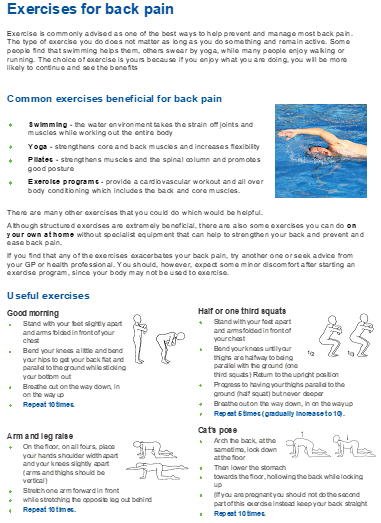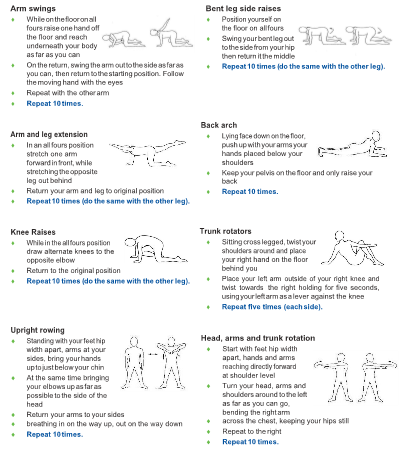
Click on the images to expand if difficult to view on your device.
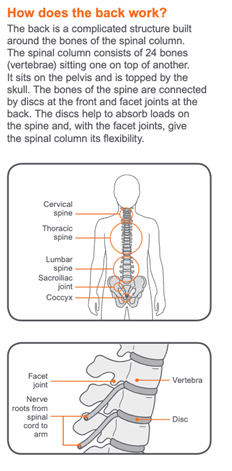
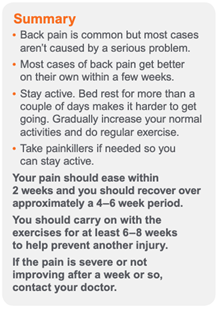
Update Jan 2025
The content continues to undergo review by all our cadres.
The content remains subject to the following provisos:
- The content will be subject to continuous update and review
- Old content (from previous CGOs) will be converted into the new format, using the new tools and layouts
- Content may be moved around
- The layout will change and reflect the needs of the user
- Content will be created
- Content may be deleted/retired
CGO development will continue.
Saf
[Updated 21 Jan 2025]
To describe the assessment and management of back pain in the deployed setting.
For the patient presenting with back pain, this guideline provides a framework to assess for potentially serious causes. If these are excluded, guidance is provided to manage the symptoms of the commonest presentation, mechanical lower back pain, and return the individual to full fitness as quickly as possible. The presence of red flags increases the likelihood of more serious pathology which may prompt further assessment as described. The focus is on acute, rather than chronic, presentations in adults.
This guideline is intended for the use of registered healthcare professionals fulfilling a general role in a forward medical location or in an Emergency Department on deployed operations.
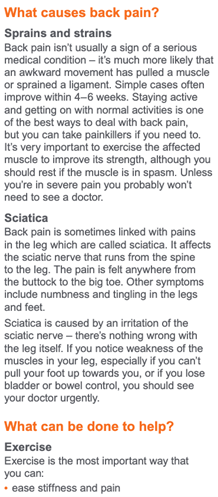
Back pain is a common complaint among the service population and a common reason for seeking medical attention. The term sciatica is often used to describe pain that radiates into the buttock or leg. In the absence of red flag features, the initial management of sciatica is the same as for lower back pain.
Potentially serious conditions causing back pain are uncommon. The following list shows relevant “red flag” features that should be considered.
If any red flag features are present, review guidance under "Advanced Assessment & Management" below.
Most patients presenting with back pain, will have “mechanical” (also referred to as non-specific or musculoskeletal) lower back pain. This is typically worse on movement.
History should include the onset, nature, time-course and location of symptoms, as well as specific features such as muscle spasm and morning stiffness.
Examination should include palpation of the spinous processes and paraspinal musculature, as well as a gross assessment of spine movement. An assessment for numbness or weakness of the lower limb should be documented. Also document relevant negative red flags above.
Occupational and operational aspects must be considered. For example, a period of light duties may be appropriate to aid recovery. If a service person is unable to carry out immediate action drills or is at risk of incapacitation due to muscular spasm, then evacuation may be appropriate.
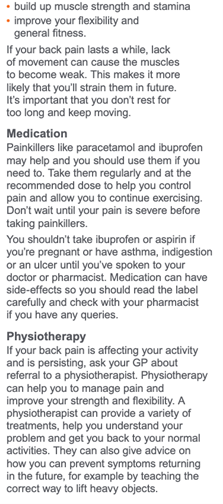
Management of acute lower back pain is usually successful in primary care and imaging is generally not recommended. Patients should be reassured that back pain is common and most people fully recover within a few weeks. It is very important to keep active as immobility can worsen and prolong symptoms. Some will find specific information and exercises are useful for reassurance and to encourage mobility.
Simple analgesia should be offered with patients encouraged to self-manage symptoms as far as possible. NSAIDs are likely to provide most benefit and should be offered with paracetamol. A short course of codeine may be required. Gabapentinoids and benzodiazepines do not have a role.
Encourage the patient to seek assessment if not improving as expected or urgently if relevant red flag features develop.
In the absence of red flag features, advanced assessment, investigation and management are rarely required. Some patients may benefit from early referral to a physiotherapist/rehabilitation specialist to regain operational fitness as quickly as possible. Specialist referral may be warranted for symptoms that are worsening or prolonged.
If red flag features are present, a serious underlying condition is more likely. These include cauda equina, cancer or spinal infection. If these are suspected, early specialist assessment and MRI are usually recommended. If there is a history of trauma, then a CT scan may be useful to identify bony injury. However, in spinal injury with neurological symptoms, an MRI is the only way to reliably identify pathology. MRI is not routinely available in the deployed setting (except via some host nations). As such early consideration should be given to evacuating these patients for ongoing care (the UK standard would be MRI within 4 hours of request in suspected cauda equina).
In addition to MRI, evacuation and specialist assessment, consider the following:
If red flags suggest the possibility of spinal infection but prompt evacuation is not possible then treat empirically with antibiotics in accordance with the antimicrobial guidance, and follow sepsis guidance if the patient is systemically unwell.
Patients with mechanical low back pain without red flags should continue to be treated with simple analgesia and encouraged to mobilise if evacuation is required but delayed.
Back pain is an uncommon presentation in children. In addition to the adult red flags, duration >2 weeks, sciatic symptoms and prominent stiffness should prompt assessment by a suitably experienced clinician.
Click on the images to expand if difficult to view on your device.
Click on the images to expand if difficult to view on your device.