
Encephalitis
Warning
Objectives
To guide the management of patients presenting to medical facilities with suspected encephalitis.
Encephalitis is a reportable disease in England and Wales. Treating clinicians should consider reporting requirements for their location and public health measures that can be found in separate guidance on notifiable diseases.
Scope
This guideline outlines the initial emergency investigation and management of a person with suspected encephalitis in military settings, from forward emergency care through stabilisation to ward-based care.
Audience
This guideline is intended for the use of registered healthcare professionals fulfilling a general role in a forward medical locations or in an Emergency Department on deployed operations.
Initial Assessment & Management
Background: Encephalitis means ‘inflammation of the brain’ and is usually the result of a viral illness. There are 2 main types, acute viral encephalitis and post-infectious encephalitis (an autoimmune condition).
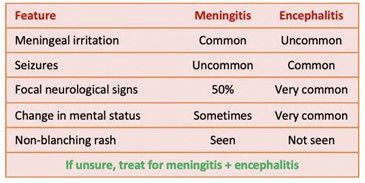
Recognition: Typical features include fever, headache, seizures and focal neurological signs or altered mental status. This can be very similar to meningitis.
Encephalitis may begin with a flu-like illness or headache, progressing to confusion, drowsiness, altered level of response, fits and coma.
Photophobia and neck stiffness may occur but are often accompanied by dysphasia, sensory changes, loss of motor control or uncharacteristic behaviour.
They may also have symptoms attributable to a rise in intracranial pressure (severe headache, dizziness, confusion or seizures).
Assessment:
- Use a structured MARCH approach.
- Check blood sugar and treat hypoglycaemia if present.
- Check and monitor vital signs (using a recognised score e.g. NEWS2).
- Complete a full neurological examination.
Treatment:There is no reliable method to distinguish meningitis (usually bacterial) from encephalitis (mostly viral).
Therefore IV/IM antibiotics should be initiated empirically in accordance with the current DMS antimicrobial policy.
If available, IV Antivirals should also be initiated in accordance with the current DMS antimicrobial policy but do not delay evacuation.
Seizures, including status epilepticus, are possible and should be treated as per the Seizure CGO.
Initiate urgent MEDEVAC from forward location to Deployed Hospital Care.
Casualties with reduced GCS, significant sepsis or behavioural disturbance may require critical care (MERT or similar) evacuation if available in the deployed setting.
Advanced Assessment & Management
Investigation:
There is no useful field diagnostic test for viral encephalitis: diagnosis will be based mainly on clinical presentation.
Blood tests should be sent when possible, including FBC, U&E, CRP, lactate, coagulation function and blood cultures (ideally prior to antibiotics). FBC may show a raised white cell count, with lymphocytes predominating.
Lumbar Puncture should be performed within the deployed hospital setting if lab facilities are able to conduct analysis (In line with the Meningitis CGO).
PCR is sensitive for diagnosing HSV-1 (the most common cause) – consider if blood samples could be sent to a host nation facility or returned to the UK if evacuation of the patient is not immediately possible.
Blood film microscopy for malaria parasites, trypanosomes or Borreliosis may be useful, depending on location prevalence (see NaTHNac or seek advice from an infectious disease specialist).
CT head, if available, will be useful to exclude cerebral abscess, space occupying lesions, traumatic brain injuries and other differential diagnoses.
Treatment:
Core treatment with IV antibiotics and antiviral medications should be continued.
Refractory agitation can be complex to manage. Atypical antipsychotics may be helpful in the short-term, if available - oral olanzapine may be available (initial dose 5mg od, can be increased to 10mg od), but benzodiazepines may be the only available pharmaceutical option. Titrate from low doses (for example lorazepam 1mg PO/IV).
Supportive care, including intensive care management may be required.
Prolonged Casualty Care
Continue regular IV antibiotics and antivirals.
Provide supportive care in line with sepsis CGO.
If agitation persists and is severe, sedation may be required: see sedation CGO.
This is caused by TBE virus and is spread by the ixodid tick, endemic in Europe, former Soviet Union and Asia.
The incubation period is 7–14 days. A 2–4 day viraemic phase can then be followed by a remission (of ~8 days) with a second febrile illness in 20–30%.
It is characterised by fever, symptoms of encephalitis, meningitis or both.
Treatment is symptomatic and the disease is rarely fatal (1–2%) although for the small proportion who develop encephalitis, it is often devastating and irreversible.
TBE vaccines are highly effective and may have been administered during pre-deployment.
JE is caused by a flavivirus infection, it is spread by the Culex Mosquito in rural parts of Asia and South-East Asia (India, China, Japan, South Korea, Indonesia, Thailand, Malaysia and Vietnam).
The incubation period is 4-14 days with most infections being mild or asymptomatic. 1:250 infections result in severe illness including a rapid onset fever, headache, neck stiffness, disorientation, seizures and coma. Approximately 30 percent of those who develop a severe illness will die. In those who survive, it is estimated that 20-30 percent will develop permanent neurological, behavioural or intellectual problems.
There is no specific treatment for JE and treatment focuses on relieving symptoms often in intensive care. Long-term care for neurological complications may be needed.