
Paediatric Life Support
Warning
Objectives
To outline the management of cardiac arrest in children 0-16 years of age
Scope
Description of paediatric resuscitation in conjunction with the Resus Council UK 2025 guideline (See below) in the R1, R2 and R3 environment.
Prolonged care
Ethical considerations in paediatric life support
It excludes resuscitation of a newborn
Audience
This guideline is intended for the use of registered healthcare professionals fulfilling a general role in a forward medical location or in an Emergency Department on deployed operations.
Initial Assessment & Management
Ensure it is safe to approach the child
Check if the child is responsive by tapping them and speaking to them loudly.
If the child responds, leave them in the position you found them and conduct a MARCH assessment.
If the child does not respond:
Summon help using Loud Vocal Alarm and/or pre-arranged communication systems such as handheld radios/ships tannoy system etc. It is important to state Paediatric Cardiac Arrest and your location. The nature of summoning this help will depend on the operational context and may not be possible in all locations.
Put the child on their back on a firm surface if possible
Open the airway
If the child looks under 1 yr/like a baby, keep the head in a neutral position and open the mouth
If the child looks over 1yr, conduct a head tilt and chin lift by placing one hand on the forehead to tilt their head back and with the other hand lift their chin
If you suspect a c-spine injury, and are trained to do so, conduct a jaw thrust
With an open airway place your face near to the child’s for no more than 10 seconds. Look for the rise and fall of the chest, listen for breath sounds at the nose and mouth, and feel for air movement on your cheek
Look for signs of life at the same time (moving, coughing)
NOTE: Children who are close to, or are in cardiac arrest can make abnormal, infrequent noisy gasps. If you are unsure if the breathing is normal, treat as NOT normal.
If the child is breathing, move into the recovery position, conduct MARCH assessment.
If the child is not breathing or breathing is abnormal
Avoid mouth to mouth.
Give 5 rescue breaths using a bag mask valve device (2-person technique if possible).
The mask should cover the nose and mouth with no air leak.
NOTE: The correct size mask may not be immediately available to you, in some cases turning an adult mask upside down can create a better seal.
NOTE: Paediatric Ambu bags may not be available, deliver breaths using available Ambu bag sufficient to see rise and fall of the chest and no further.
If there are signs of life continue breaths until the child starts to breath for themself
If there are no signs of life following the rescue breaths:
Start chest compressions at a rate of 100-120 per minute
Continue compressions and breaths at a ratio of 15:2 (compressions: breaths)
Count out loud so your team can hear you
Under 1 year – use either two thumb encircling (figure a) or two fingers (figure b) technique on the lower half of the sternum between nipples
Over 1 year – use the heel of one hand (figure c), with a straight arm between nipples on the lower half of the sternum
Aim for a depth of 1/3 of the chest.
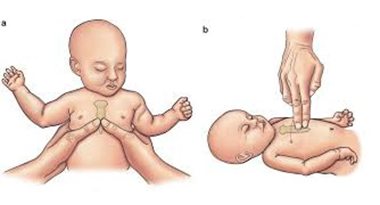
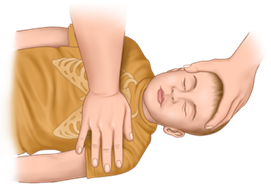
Fig A Fig B Fig C
Advanced Assessment & Management
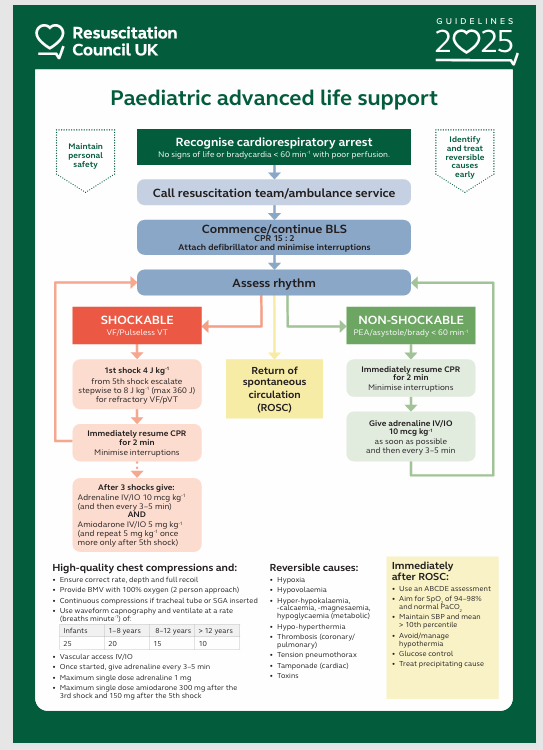
Intermediate and Advanced Life Support (see below flowchart)
- CPR is ongoing in the child
- Delegate a team member to bring up Page per Age CGO for the child (an estimation of age is fine)
- Delegate a team member to obtain IO access
- Attach the defibrillator
- Without interrupting chest compressions, place the pads on the anterior/lateral pad position (as per the picture on the pads) or in the anterior/posterior pad position.
NOTE: If no paediatric pads are available, you can use adult pads
NOTE: If an AED without a paediatric mode is present use it in adult mode
- Assess rhythm
If shockable – select the charge as per the AED or as advised in Page per Age when using a manual defibrillator (1 x 4J/kg - round up to the nearest value) and deliver shock.
If non-shockable
- Continue CPR and give adrenaline IV/IO ASAP– as per Page per Age (10mcg/kg or 0.1ml/kg 1:10000 adrenaline minijet -max 1mg per injection) followed by a 10ml flush
- Resume CPR.
- Assess rhythm every two minutes.
Shockable Rhythms
After a total of 3 shocks give adrenaline every alternate cycle IO as per Page per Age
(10mcg/kg or 0.1ml of 1:10000 adrenaline minijet (max 1mg per injection)
Give amiodarone IO as per Page per Age (5mg/kg after 3rd and 5th shock (max 300mg per dose)
All drug administration should be followed by a 10ml flush
Non- Shockable Rhythms
Give adrenaline IO as per Page per Age every alternate cycle
(10mcg/kg or 0.1ml of 1:10000 adrenaline minijet (max 1mg per injection)
All drug administration should be followed by a 10ml flush
Prolonged Casualty Care
Identify and treat four H’s and 4 T’s
| 4 H's | 4T's |
| Hypovolemia | Tension pneumothorax |
| Hypoxia | Toxic agents |
| Hypo-hyperthermia | Tamponade |
| Hyperkalaemia, Hypoglycaemia, hypercalcaemia | Thrombosis |
- If available, consider a blood sample for iSTAT
- An advanced airway (Igel/ETT) can be considered. Selection as per Page per Age. Be prepared to go up or down a size.
Once a definitive airway is established insert capnography and ventilate at:
| Age (years) | <1 | 1-8 | 8-12 | >12 |
| Breaths min-1 | 25 | 20 | 15 | 10-12 |
- Conduct A-E/MARCH assessment of the child as per an adult patient
- Keep the child continuously monitored, if possible
- Arrange transfer to R2/3 (if eligible) or local facility for further assessment
NOTE: the child may become unstable / suffer cardiac arrest again. Ensure you have the equipment ready to act quickly
Deciding when to start and stop resus
Hard stops:
- When your safety cannot be assured
- When the injury is obvious to be not survivable or has led to irreversible death (sometimes hard to determine)
- When a valid and relevant decision becomes available that recommends against the provision of CPR.
Consider stopping:
- If after persistent ongoing CPR for 20mins there are no signs of life and no further ability to treat 4Hs and Ts
- When evidence that further CPR would not be consistent with the patient’s and/or family’s preferences or best interests
Family Members
During resuscitation it is standard practice in the UK to allow family members to be present. This is on the understanding that a team member is allocated to explain what is occurring and that the family do not detract from the ongoing resuscitation efforts. (R2/R3)
Service Personnel
- Paediatric resuscitation and/or deaths can be particularly distressing for all team members involved
- Hot and cold debriefs should be conducted when appropriate
- Consider TRiM