Objectives
To outline paediatric seizure (including febrile seizure) diagnosis and management in the deployed setting including guidance about which patients should require onward referral.
Scope
- Diagnosis
- Investigations
- Management
- Onward care
Febrile Convulsions are covered in the section at the end of this CGO
Audience
This guideline is intended for the use of registered healthcare professionals fulfilling a general role in a forward medical location or in an Emergency Department on deployed operations.
Initial Assessment & Management
Use Page per Age in conjunction with this guideline for drug doses
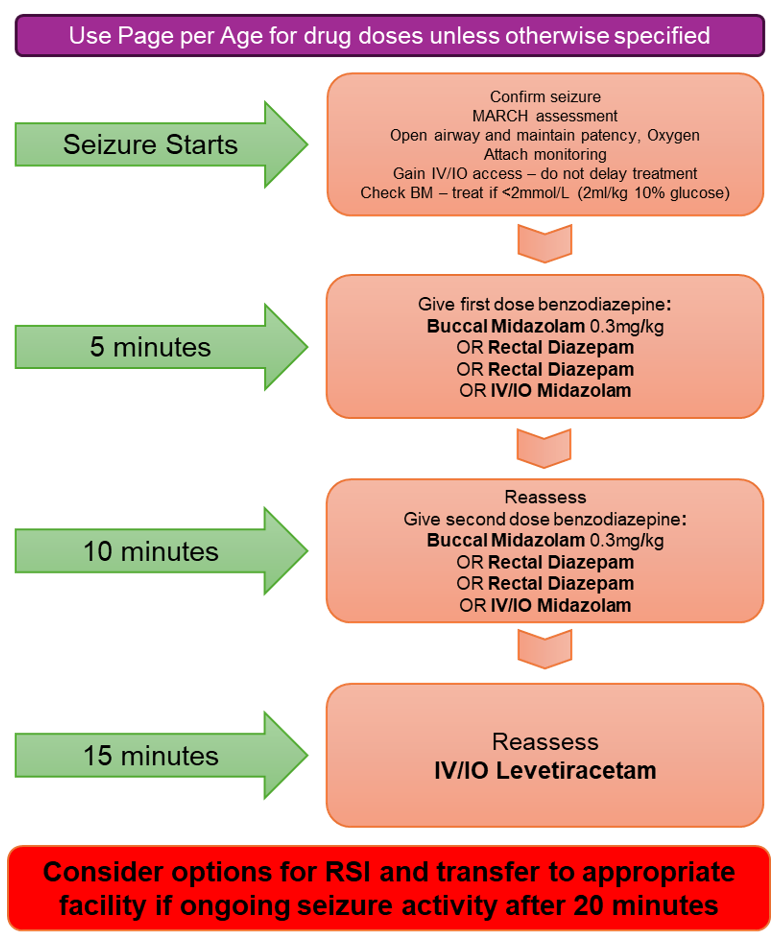
Seizure starts (time 0):
Perform rapid ABCDE/MARCH assessment and ensure safety of child as much as practicable.
Use blankets etc to help cushion head from trauma during seizure but do not restrain patient as this will cause further harm.
Try not to move child during seizure unless to remain in place would put them/you at further danger.
Open airway and maintain patency by appropriate means (NPA/OPA if necessary)
Administer oxygen
Establish duration of seizure and prepare medications (see below)
Gain IV/IO access but do not delay treatment to do so.
Measure Blood sugar and treat if <2mmol/L with 2ml/kg 10% glucose
VBG if iSTAT capabilities are available.
If hyponatraemic (<125 mmol/L) give 3ml/kg 3% sodium chloride over 20mins and continue seizure management as below.
5 minutes:
Give first dose benzodiazepine:
Buccal midazolam, 0.3 mg/kg
OR Rectal diazepam (page per age)
10 minutes:
Give second dose of benzodiazepine:
Buccal midazolam, 0.3 mg/kg
OR Rectal diazepam (page per age)
OR IV midazolam 0.2mg/kg
15 minutes:
Give 40mg/kg Levetiracetam IV/IO over 5 minutes.
A child with a seizure not terminating after 15 mins with 2 doses of benzodiazepines may require intubation via general anaesthetic. If this is not available at your setting, then the child should be moved as soon as practicable to a local national facility or R2/3.
20 minutes:
If appropriate, consider general anaesthetic and onward evacuation to a suitable facility.
If the child has stopped seizing:
Perform an ABCDE/MARCH assessment. Ensure not continuing to seize and assess for post ictal state.
If the child has been given benzodiazepines, monitor respiratory rate. Children can experience a profound respiratory depression following administration of benzodiazepines. If hypoventilating, then supportive ventilations using an appropriate BVM should be sufficient until the side effects have subsided.
Check the capillary glucose of the child and perform full observations including temperature. If child is febrile or has been febrile immediately preceding the seizure, then follow guidance below for febrile seizure.
Monitor child until they are back to their baseline behaviour. If prolonged post ictal period or unusual neurology, then consider immediate evacuation to a local healthcare setting for further investigations. This will be beyond the scope of deployed healthcare facilities.
Once the child is at their baseline and has fully recovered, then they should be referred into their local healthcare setting for formal review. This does not need to be immediate but should occur in a timely fashion to allow for further investigations to occur that are beyond the scope of deployed healthcare.
Advanced Assessment & Management
Conditions that might mimic typical seizures and require alternative management:
- Transient LOC due to insufficient cerebral blood flow often caused by hypotension.
- Rapid onset, short duration, spontaneous complete recovery.
- Breath-holding spells/Reflex anoxic seizures.
- Brief, involuntary cessation of breathing often triggered by sudden, unexpected fright, fear or pain. May present with pallor or cyanosis and low tone, with possible LOC and transient tonic-clonic movements if the apnoea is prolonged.
- Sleep disorders/night terrors
- Non-epileptic attack disorders (psychogenic non-epileptic seizures, dissociative seizures, or pseudo seizures).
Potential causes for seizures that might require further investigation in appropriate facility:
- Epilepsy – this diagnosis requires specialist investigation outside the OPCP.
- Head injury
- Hypoglycaemia
- Hyponatremia
- Drug use or withdrawal
- Space Occupying Lesions
- Other neurological conditions such as cerebral palsy or neurocutaneous syndromes where seizures may form part of the condition.
Arrange rapid transfer to suitable facility if:
- Hyponatraemia
- Ongoing uncontrolled seizures
- Prolonged postictal period or concerning new neurological signs post seizure
- Suspected serious or life-threatening cause of fever
- A febrile seizure in children <18months without an obvious source of fever - CNS infection maybe subtle in this age group so consider empirical treatment
- Any ongoing professional concern about the child