
Mesenteric ischaemia
Objectives
To provide guidance for the identification and management of mesenteric ischaemia
Scope
These guidelines are for deployed clinicians who manage patients who require laparotomy or Damage Control Surgery for traumatic mesenteric ischaemia. Non-traumatic mesenteric ischaemia is beyond the scope of this guideline.
Audience
All clinicians within the deployed setting (including surgeons, anaesthetists, Intensive Care Unit providers, nursing staff and perioperative practitioners) who may be required to care for patients with the potential for traumatic or non-traumatic mesenteric ischaemia.
Initial Assessment & Management
Mesenteric ischaemia can be the result of traumatic injury – either blunt or penetrating injury of the abdomen or rapid deceleration. Non-traumatic presentations are usually due to an embolic event but can include mesenteric venous thrombosis or arterial thrombosis in-situ. Mesenteric Ischaemia can occur in the absence of direct trauma as a result of hypovolaemia or traumatic cardiac arrest. In early assessment of a trauma patient a diagnosis of Mesenteric Ischaemia may not be apparent but may develop over the next few hours, particularly in patients being managed non-operatively initially.
Initial assessment and management within the deployed setting depends on the medical facility capabilities and the number of simultaneous casualties.
Presentation consists of generalised abdominal pain often out of proportion to the clinical findings. Nausea and vomiting is often associated. Findings on abdominal examination are usually generalised tenderness. Features of peritonitis (guarding, rebound tenderness) are a late sign and suggests infarction rather than developing ischaemia.
Investigations involve a blood gas measurement to check lactate, however a normal lactate should not be reassuring as this can be normal even in severe cases of mesenteric infarction.
Initial Management is urgent resuscitation with intravenous fluids, urinary catheter and broad spectrum antibiotics.
Advanced Assessment & Management
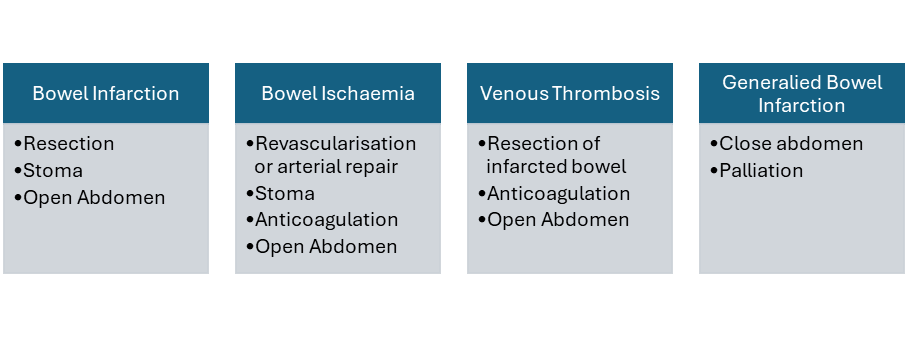
Management of Acute Mesenteric Ischaemia is a surgical emergency and an urgent laparotomy is needed. Excision of infarcted bowel is required and the patient would most likely need a stoma, an open abdomen and a relook in 24-48hrs.
For ischaemic bowel that has not yet infarcted there may be an option for revascularisation based upon surgical experience, facility capabilities and the tactical situation. This would most likely be feasible if the presence of a proximal injury or occlusion is identified in which an embolus or thrombus can be removed with a mesenteric arterial embolectomy with an arterial repair (direct or patch) or bypass (vein or prosthetic) in penetrating injury. In this situation then revascularized ischaemic bowel can be left in situ and the patient monitored with a laparostomy and relook in 24-48hrs. In extremis then ligation can be considered as a Damage Control option but there is a high chance of mortality or severe morbidity from this.
In patients with Mesenteric Venous Thrombosis management is much the same as an arterial cause with resection of infarcted bowel and anticoagulation. Intraoperatively and in the early post operative phase then this is advised to be IV heparin but following the immediate post operative phase, assuming there is no evidence of further bleeding, with treatment dose Low Molecular Weight Heparin. https://tccc.org.ua/en/collection/clinical-practice-guidelines#сlinical-guidelines-cpg
In patients who have extensive bowel infarction this is sadly not compatible with life and therefore the abdomen should be closed and the patient palliated.
Prolonged Casualty Care
These patients will need ongoing resuscitation and careful monitoring for further ischaemia, particularly in those that revascularisation or arterial repair is not an option. They will need further surgery at 24-48hrs. Where practicable patients should be evacuated as early as possible following initial laparotomy for further management.
Paediatric Considerations
There are no special consideration for paediatric patients and therefore management should be as these adult guidelines.